
A mature oil field can appear to be running out of options. Production has declined for years, water handling costs are climbing, and wells that once flowed strongly now need artificial lift just to maintain modest rates.
Yet a large volume of oil may still remain in the rock. Primary production and waterflooding do not sweep every pore, and they do not fully overcome the capillary forces that hold oil in place. The question is whether that remaining oil can be recovered economically and responsibly.
Enhanced oil recovery, usually shortened to EOR, is the set of methods designed to mobilize or displace oil that conventional recovery leaves behind. It is often discussed as a way to extend the useful life of mature reservoirs, but its efficiency is never automatic.
For students, the key lesson is that EOR is not a single technology with a fixed recovery percentage. For working professionals, the practical challenge is choosing a process that matches the reservoir, fluid system, facilities, economics, and operating constraints.
🛢️ What Makes a Reservoir “Mature”?
A mature reservoir is generally one that has passed its early production plateau and is experiencing established decline. It often has extensive production history, a developed well network, and existing surface infrastructure.
Maturity does not mean depletion in a simple sense. A field may have produced a substantial amount of oil while still retaining considerable residual oil: oil that remains trapped after earlier displacement processes.
These reservoirs are attractive EOR candidates because their geology, pressures, water cut, and well performance are better understood than those of a new discovery. However, age can also mean corroded facilities, damaged wells, complex water management, and legacy data gaps.
📉 Why Conventional Recovery Leaves Oil Behind
During primary recovery, oil moves toward wells because of natural reservoir energy, such as gas expansion, an active aquifer, or gravity drainage. This phase commonly captures only a portion of the original oil in place.
Secondary recovery, most often water injection, improves pressure support and pushes oil toward producers. But injected water preferentially follows more permeable pathways, so it may bypass tighter zones and break through early at production wells.
At pore scale, water can also flow around droplets of oil without dislodging them. At field scale, reservoir layering, faults, fractures, and uneven injection patterns create areas that the flood never contacts effectively.
🎯 The Meaning of EOR Efficiency
Asking how efficient EOR is requires a precise definition. Efficiency may refer to additional oil recovered, the fraction of injected material that contributes to displacement, energy use per barrel, project profitability, or the carbon intensity of operations.
Engineers commonly separate recovery performance into microscopic displacement efficiency and macroscopic sweep efficiency. The first describes how effectively oil is mobilized where the injected fluid contacts it. The second describes how much of the reservoir is actually contacted.
A method can excel at one and fail at the other. For example, a miscible gas may mobilize oil very effectively in contacted rock, yet deliver disappointing field results if it channels quickly through high-permeability layers.
🧭 Recovery Factor Is the Main Field Metric
The recovery factor is the proportion of original oil in place ultimately produced. EOR performance is often expressed as an incremental recovery factor, meaning the additional recovery beyond primary and secondary methods.
There is no universal incremental recovery number. It depends on oil viscosity, reservoir temperature and pressure, rock properties, heterogeneity, fluid composition, well spacing, and how well the process is controlled.
For that reason, a forecast should be treated as a range based on scenarios, not as a promise. The meaningful comparison is between forecast incremental barrels and the costs, emissions, timing, and risks required to obtain them.
🌡️ The Three Main Families of EOR
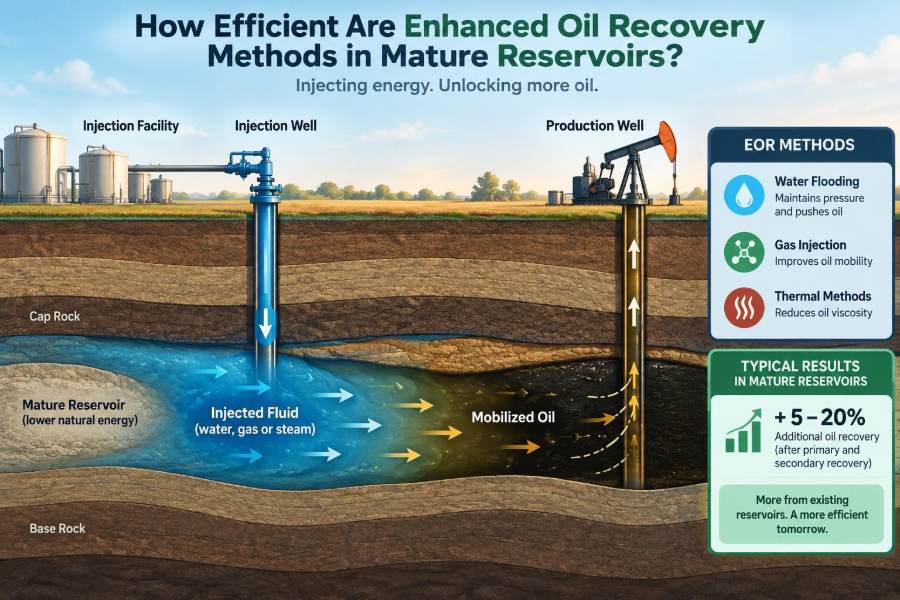
EOR is commonly grouped into thermal, gas injection, and chemical methods. Each family targets one or more barriers that prevent oil from moving: high viscosity, high interfacial tension, unfavorable mobility, or poor sweep.
| Method family | Primary mechanism | Typical strongest fit | Common limitation |
|---|---|---|---|
| Thermal | Reduces oil viscosity with heat | Heavy, viscous oil | Heat loss and high fuel or energy demand |
| Gas injection | Swells oil, lowers viscosity, or becomes miscible | Suitable pressure and compatible oil composition | Gas channeling and supply constraints |
| Chemical | Improves sweep or mobilizes trapped oil | Reservoirs with favorable salinity and temperature | Chemical degradation, retention, and cost |
Hybrid projects are also possible. A gas process may use foam to control mobility, or a chemical process may be paired with carefully managed water injection.
🔥 Thermal EOR and Viscosity Reduction
Thermal EOR adds heat to reduce the viscosity of heavy oil. A familiar analogy is warming thick syrup: as temperature rises, it flows more readily.
Steam injection is the most established thermal approach. In cyclic steam stimulation, a well receives steam, rests while heat transfers into the formation, and then produces. Steamflooding uses injector wells to drive heated oil toward producers.
Combustion-based approaches generate heat within the reservoir, but they require careful control of reaction behavior and produced-gas handling. Thermal methods can be highly effective in suitable heavy-oil settings, but are rarely logical for light oils that already flow easily.
💨 Gas Injection and Oil Miscibility
Gas EOR can use carbon dioxide, hydrocarbon gas, nitrogen, or other gases depending on fluid properties and project objectives. The injected gas may dissolve in oil, swell it, reduce its viscosity, vaporize lighter components, or help maintain reservoir pressure.
At sufficient pressure and compatible composition, a gas can become miscible with the oil. In a miscible displacement, the interface between gas and oil becomes much less distinct, reducing the capillary trapping that limits ordinary waterfloods.
The pressure required for this behavior is not a generic value; it is determined through fluid characterization and laboratory testing. If reservoir pressure cannot be maintained near the required range, expected performance may not materialize.
🌊 Water-Alternating-Gas Improves Control
Injected gas is often much less viscous than oil and water. Without control, it can finger through the reservoir, reach producers early, and leave large volumes of oil unswept.
Water-alternating-gas, or WAG, cycles slugs of water and gas. Water helps reduce gas mobility and can improve vertical and areal sweep, while gas contributes the favorable phase behavior needed to mobilize oil.
WAG is not automatically superior to continuous gas injection. The optimal cycle size, gas-water ratio, injection rate, and response to heterogeneity must be evaluated for the specific reservoir and well pattern.
🧪 Polymer Flooding Improves Mobility Ratio
Polymer flooding adds water-soluble polymers to injection water, increasing its viscosity. The goal is to prevent water from racing ahead of oil through the easiest flow paths.
This improves the mobility ratio, a comparison of how readily the displacing phase moves relative to the displaced oil. A more favorable mobility ratio generally supports a more stable flood front and better sweep.
Polymer performance can be affected by high temperature, high salinity, divalent ions, mechanical degradation, and adsorption onto rock. Produced-water treatment and polymer handling also need to be built into facility design rather than treated as an afterthought.
🫧 Surfactants Target Trapped Oil
Surfactants are chemicals that reduce interfacial tension between oil and water. Lowering that tension can help release oil droplets held in small pore throats by capillary forces.
Surfactant flooding can therefore improve microscopic displacement efficiency, especially after a waterflood has left oil trapped in contacted zones. It is technically demanding because surfactants may adsorb onto minerals, degrade under reservoir conditions, or perform poorly in incompatible brines.
Formulation work is central. A chemical system that looks promising in a simple laboratory fluid may fail when exposed to the actual reservoir brine, crude oil, temperature, and rock minerals.
🧂 Alkaline and ASP Processes
Alkaline chemicals can react with acidic components in certain crude oils to generate surface-active species in situ. This can lower interfacial tension, though the approach is highly dependent on crude composition and water chemistry.
An ASP flood combines alkaline, surfactant, and polymer components. In principle, the surfactant helps mobilize trapped oil while the polymer improves sweep; the alkaline component can support surfactant behavior and reduce adsorption in some systems.
The combined process is complex. Scaling, emulsion formation, chemical logistics, compatibility with produced fluids, and separation challenges can reduce practical efficiency even when displacement tests are encouraging.
🪨 Rock Properties Set the Boundaries
Permeability controls how easily fluids flow, while porosity describes the volume available for fluids. Neither property alone determines EOR suitability; their distribution matters just as much.
Wettability is particularly influential. It describes whether a rock surface preferentially contacts water or oil. Wettability affects residual oil saturation, relative permeability, capillary pressure, and the way injected fluids occupy pore space.
Clay minerals, fine particles, and narrow pore throats can create problems for chemical systems. They may retain chemicals, alter flow behavior, or migrate when salinity changes, potentially reducing injectivity near wells.
🧩 Heterogeneity Often Decides Field Results
Reservoir heterogeneity means that properties vary from place to place. A reservoir may contain high-permeability streaks, low-permeability barriers, channels, fractures, or layers with very different flow behavior.
In such settings, an injected fluid follows the path of least resistance. This is why an excellent coreflood result does not guarantee an excellent field result: a core sample cannot fully represent kilometers of geological complexity.
Pattern design, conformance control, selective completions, zonal isolation, and surveillance are tools for managing heterogeneity. They do not eliminate uncertainty, but they can prevent the most obvious bypassing mechanisms.
🧱 Fractures Can Help or Hurt
Natural fractures can provide rapid flow paths and may improve production from otherwise tight rock. During EOR, however, they may also short-circuit injected water, steam, or gas directly to producers.
Whether fractures are beneficial depends on their connectivity with the rock matrix. In a fractured carbonate, for example, the matrix may store most of the oil while fractures carry most of the injected fluid.
Successful designs may rely on gravity drainage, imbibition, controlled injection rates, or mobility-control agents to encourage exchange between fracture and matrix. Treating all fractures as either good or bad is an oversimplification.
🛢️ Oil Properties Determine the Best Mechanism
Heavy oil usually benefits most from viscosity reduction, making thermal techniques natural candidates when depth, heat loss, and environmental constraints allow. Light oil may be a better candidate for miscible gas processes.
Oil composition also affects minimum miscibility behavior, swelling, chemical reactions, and emulsion tendency. Density and viscosity are useful screening indicators, but they are not sufficient by themselves.
A mature reservoir with moderately viscous oil might respond well to polymer flooding if sweep is the central problem. The same reservoir may not justify steam injection if heating does little to improve its flow behavior.
⚖️ Mobility Control Is a Repeating Theme
Many EOR disappointments trace back to poor mobility control. If the injected phase moves much more easily than the oil, it bypasses rather than displaces.
Polymers thicken water; WAG introduces water to restrain gas; foams can reduce gas mobility in selected conditions; gels and relative-permeability modifiers may reduce flow through thief zones. Each method has limitations, especially around placement and long-term stability.
The practical objective is not simply to inject more material. It is to direct the right fluid toward unswept oil at a rate the reservoir can accept without creating early breakthrough or damaging near-wellbore permeability.
🔬 Laboratory Work Reduces Early Uncertainty
Laboratory studies establish whether an EOR concept is physically plausible. Relevant work can include pressure-volume-temperature analysis, slim-tube tests for miscibility screening, corefloods, phase-behavior experiments, rheology tests, and chemical compatibility studies.
Representative samples matter. A test using fresh water, simplified oil, or an unrepresentative core can produce results that are too optimistic for field conditions.
Laboratory evidence should answer practical questions: Does the chemical survive? Does gas achieve the intended phase behavior? Does the rock retain too much agent? Can the expected incremental oil be distinguished from ordinary waterflood response?
💻 Simulation Connects Physics to Field Design
Reservoir simulation combines geological models, well data, fluid properties, and flow equations to forecast alternative development plans. For EOR, the simulator may need thermal, compositional, chemical, or geomechanical capabilities depending on the process.
Simulation is valuable for testing well patterns, rates, timing, pressure limits, and sensitivity to uncertain properties. It is not a crystal ball: a detailed model can still be wrong if its assumptions about permeability distribution or relative permeability are wrong.
History matching—adjusting model parameters until the model reproduces past field behavior—is useful, but it should not become a way to hide uncertainty. Multiple plausible matched models may predict different EOR outcomes.
🧭 Pilot Tests Are the Bridge to Scale-Up
A field pilot tests the EOR process under real reservoir and operational conditions. It can reveal injectivity problems, unexpected breakthrough, facility constraints, poor conformance, or a production response different from simulation forecasts.
A useful pilot begins with clear success criteria. These may include pressure response, tracer behavior, chemical retention, produced-fluid changes, conformance indicators, and incremental oil measured against a credible baseline.
Scale-up requires caution. A pilot covers a limited part of the reservoir and may be located in a more favorable area. Its result must be interpreted in the context of geology beyond the pilot boundaries.
📡 Surveillance Turns EOR into a Managed Process
Once injection starts, surveillance is essential. Injection volumes alone do not show where fluids are going or whether they are contacting the intended reservoir zones.
Useful data may include injection pressure, rate, produced gas-oil and water-oil ratios, fluid composition, tracers, pressure interference, temperature profiles, production logging, and repeated saturation monitoring where feasible.
Surveillance supports an iterative workflow: observe a response, update the reservoir understanding, adjust operations, and test whether the change improves performance. In mature fields, this feedback loop can be as valuable as the original process selection.
🏭 Surface Facilities Can Limit Recovery
EOR changes what arrives at the surface. Steam projects require water treatment, steam generation, fuel or power, and heat management. Gas projects need compression, recycling, dehydration, separation, and safe containment.
Chemical floods may create stable emulsions or produce fluids that challenge separators and water-treatment systems. Polymer can affect filtration, pumps, and disposal operations.
A technically sound reservoir concept can fail economically if facilities cannot process the produced fluids reliably. Facility engineers should therefore be involved during screening, not only after a reservoir team selects a preferred method.
💰 Efficiency Must Include Economics
Producing an extra barrel is not necessarily an efficient outcome if its full cost exceeds its value. Economic evaluation includes capital spending, operating costs, chemical or gas supply, energy demand, water treatment, workovers, maintenance, and the time value of money.
Timing matters. Some EOR processes require a substantial injection period before incremental oil becomes visible. A project with strong ultimate recovery may still be unattractive if cash flow arrives too late or if price uncertainty is unacceptable.
Decision-making is stronger when it uses sensitivity cases rather than a single commodity-price assumption. The goal is to understand which uncertainties most affect the decision and which can be reduced through a pilot or additional data.
🌍 Energy Use and Emissions Need Honest Accounting
Thermal EOR can require significant energy to generate steam, while compression and recycling can be major loads in gas injection. Chemical manufacture, transport, and water treatment also contribute to the project footprint.
Some carbon dioxide injection projects may include storage objectives, but storage and EOR are not interchangeable terms. The climate outcome depends on the full system boundary, including the source of carbon dioxide, monitoring approach, recycle volumes, energy use, and the fate of produced oil.
Transparent lifecycle assessment is more useful than broad claims. Operators should quantify relevant inputs and emissions using methods appropriate to their regulatory and operational context.
💧 Water Management Is Central in Mature Fields
Mature reservoirs frequently produce large water volumes. EOR can increase water handling needs, alter produced-water chemistry, or require a dependable supply of injection-quality water.
Produced water may contain oil, dissolved salts, solids, scale-forming ions, and treatment chemicals. Reuse can be beneficial where compatible, but water chemistry must be controlled to avoid plugging, scaling, souring, or chemical performance loss.
Water planning should cover sourcing, treatment, injection, recycling, disposal capacity, leak prevention, and contingency response. It is a core design issue, not a peripheral environmental task.
🛡️ Integrity and Containment Cannot Be Assumed
Mature fields may include old wells drilled under different practices and documented with incomplete records. These wells can be potential pathways for unwanted fluid or gas movement if barriers are degraded.
Before changing reservoir pressure or injecting new fluids, teams need to assess well integrity, cement condition, casing corrosion, abandoned-well locations, and pressure limits. Monitoring plans should be matched to the specific fluid and containment risks.
Pressure management is especially important in gas injection and in reservoirs with nearby faults or sensitive formations. Operating below defined limits is a risk-control measure, not merely a production constraint.
⚠️ Common Reasons EOR Projects Underperform
Underperformance usually comes from a mismatch between the process and the reservoir, not from one isolated operational mistake. Common causes include:
- Overestimating sweep in a highly heterogeneous reservoir.
- Using laboratory results that do not represent actual brine, oil, or rock.
- Insufficient gas pressure for the intended miscible mechanism.
- Ignoring chemical retention, degradation, or injectivity losses.
- Choosing well patterns that cannot control channeling.
- Underestimating produced-fluid treatment and facility modifications.
- Claiming incremental oil without a robust baseline for comparison.
These failures are avoidable only in part. The better approach is to identify them early, quantify their possible impact, and design staged decision points rather than committing to full deployment too soon.
🧮 Screening Is Better Than Starting with a Favorite Method
Teams sometimes begin with an available resource—nearby carbon dioxide, an existing steam plant, or a familiar chemical supplier—and work backward. That can be practical, but it risks forcing a method onto an unsuitable reservoir.
A disciplined screening process starts with reservoir temperature, depth, pressure, oil properties, permeability, salinity, lithology, heterogeneity, infrastructure, and constraints. It then compares mechanisms rather than brands or trends.
- Define the remaining-oil problem: viscosity, trapping, poor sweep, or pressure loss.
- Eliminate methods that conflict with reservoir and fluid conditions.
- Rank feasible options by technical fit, operational complexity, economics, and risk.
- Collect targeted data to resolve the uncertainties that drive the ranking.
- Design a pilot with measurable decision criteria.
🔄 Combining EOR with Better Reservoir Management
Not every mature field needs a full EOR campaign immediately. Infill drilling, recompletions, waterflood pattern balancing, injection-profile control, artificial-lift optimization, and shutoff of unwanted water can sometimes recover value at lower complexity.
These measures may also improve an eventual EOR project. For example, repairing poor injection allocation before polymer flooding can prevent costly polymer from entering thief zones.
The strongest development plan often uses a portfolio: conventional optimization for accessible opportunities and EOR for oil that remains inaccessible after those measures are exhausted.
👷 Cross-Disciplinary Decisions Improve Outcomes
EOR sits at the intersection of reservoir engineering, geology, petrophysics, production engineering, facilities, chemistry, economics, environmental management, and operations. A technically elegant displacement mechanism can be undermined by a pump limitation or water-treatment bottleneck.
Regular integration helps teams challenge assumptions early. Geologists can flag uncertain connectivity; production engineers can identify wellbore constraints; facility teams can test separation capacity; commercial teams can frame the decision under realistic price and supply scenarios.
For early-career engineers, this is a useful reminder that EOR is not merely a reservoir-simulation topic. Its field performance depends on the whole asset system.
📚 What “Efficient” Looks Like in Practice
An efficient EOR project does not necessarily produce the highest possible incremental recovery factor. It produces a defensible volume of incremental oil with acceptable capital, operating burden, safety performance, environmental management, and uncertainty.
That may mean accepting a simpler polymer flood over a more theoretically powerful chemical process, or choosing targeted gas injection in the best-connected zones rather than attempting full-field deployment.
Efficiency is therefore a balance between technical recovery, sweep quality, operational reliability, and value creation. Mature reservoirs reward careful matching and continuous adaptation more than one-size-fits-all solutions.
✅ The Core Takeaway for Mature Reservoirs
Enhanced oil recovery can be highly effective in mature reservoirs because substantial oil commonly remains after primary production and waterflooding. But the remaining oil is difficult precisely because it is trapped, bypassed, highly viscous, or located in complex parts of the reservoir.
The most reliable path is systematic: define the recovery limitation, characterize the rock and fluids, screen mechanisms, test representative conditions, model uncertainty, run a measurable pilot, and use surveillance to refine operations.
No EOR method is universally efficient. Thermal, gas, and chemical approaches each solve different flow problems and each introduces its own demands on wells, facilities, energy, water, and risk management.
The efficiency of EOR is determined less by the name of the method than by how precisely its mechanism matches the reservoir and how rigorously the project is managed from laboratory to field scale. 🛢️🔬🌍