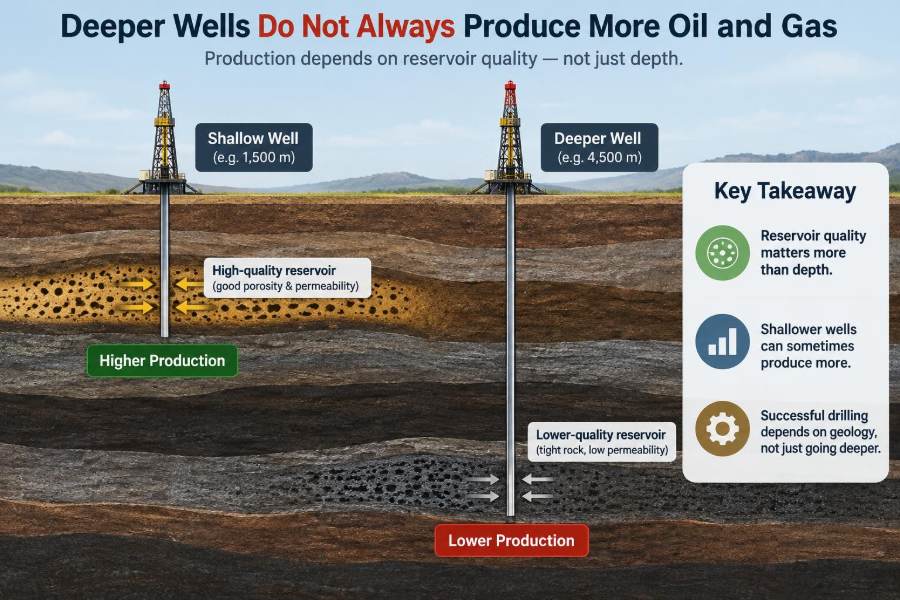

A drilling rig reaches a target depth, and the number sounds impressive: several kilometres below the surface. It is tempting to assume that the deeper well must be the better well—the one with more hydrocarbons, higher production, and greater value.
That intuition appears in classroom discussions, project conversations, and public descriptions of oil and gas operations. Depth is visible, measurable, and easy to compare. Reservoir quality is harder to see because it depends on rock properties, fluid behavior, pressure, well design, and economics.
A shallow well can be highly productive, while a much deeper well may be tight, water-prone, technically difficult, or commercially uneconomic. Conversely, some deep reservoirs are exceptional producers. The difference lies not in depth alone, but in the complete petroleum system and the way the well connects to it.
Understanding that distinction helps engineers avoid a costly mental shortcut: treating depth as a proxy for reserves or flow rate.
🧭 The simple answer: depth is not productivity
Well depth tells us where a target lies vertically or along the drilled path. Production depends on whether hydrocarbons are present, whether the reservoir can deliver them to the wellbore, and whether the well can produce them safely and economically.
A useful question is not, “How deep is the well?” It is: What is the quality, pressure, extent, and connectivity of the reservoir reached by the well? A deep borehole may pass through several poor intervals before reaching one productive zone. A shallow well may intersect an excellent reservoir almost immediately.
🪨 Reservoir rock is the real starting point
Oil and gas do not occupy large empty underground caverns in the usual reservoir model. They sit in tiny connected pore spaces within rocks such as sandstone or carbonate. The rock must store fluids and provide pathways for those fluids to move.
Two properties dominate the first assessment: porosity, the fraction of rock volume that can contain fluids, and permeability, the ability of those fluids to flow through connected pores. Neither property automatically improves with depth.
🕳️ Porosity often declines with burial
As sediment is buried, the weight of overlying rock compresses it. Grains may pack closer together, and pore volume can decrease. Mineral cement can also grow between grains and occupy pore spaces.
This means a deep sandstone may have less storage capacity than its shallower equivalent. The outcome varies by geological history: some deep reservoirs preserve useful porosity through favorable grain composition, early hydrocarbon charge, or later dissolution of minerals. But depth alone does not protect pore space.
🚪 Permeability controls whether fluids can move
A reservoir can hold hydrocarbons and still produce poorly if its pore throats are too narrow or disconnected. Permeability measures flow capacity, so it strongly affects the rate at which oil, gas, or water can travel toward a well.
Think of porosity as the number of rooms in a building and permeability as the width and continuity of its hallways. Many rooms do not help much if nearly all doors are closed. Deep compaction and cementation can narrow those pathways considerably.
📉 Compaction changes the rock as depth increases
Increasing depth commonly means greater effective stress: the stress carried by the rock framework after accounting for pore pressure. Higher stress can close microfractures and constrict pore throats, particularly in weakly consolidated sands or naturally fractured formations.
The result may be lower permeability near the wellbore, where pressure reduction during production raises effective stress further. Engineers therefore evaluate stress sensitivity rather than assuming laboratory rock properties remain unchanged during field depletion.
🧱 Cementation can create a deep, tight reservoir
Minerals transported by formation water can precipitate inside pore spaces over geological time. Quartz, calcite, clays, and other cements may turn a once-open sand into a tight formation with limited flow capacity.
Such a formation may contain gas, yet require hydraulic fracturing or other stimulation to produce at a commercial rate. It is not “bad” simply because it is deep; it is a different reservoir-development problem with different costs and uncertainties.
💧 Fluid saturation matters as much as pore space
Not every pore in a reservoir contains oil or gas. Some hold irreducible water, while other portions may be water-filled because of the reservoir’s position relative to a water contact.
Hydrocarbon saturation describes the share of pore volume occupied by oil or gas. A porous, permeable interval with high water saturation may produce mostly water rather than the target hydrocarbon. Depth cannot reveal this by itself; logs, cores, pressure data, and fluid samples are used to interpret it.
🌊 Water contacts can limit productive thickness
In many reservoirs, denser water sits below oil, and oil sits below gas. The transition may be sharp or gradual depending on rock type and capillary forces. A well drilled lower on a structure may encounter more water even when it reaches the same formation as a successful nearby well.
This is why structural position matters. A shallower well near the crest of an anticline can access an oil or gas column, while a deeper well on the flank can enter the water leg.
🗺️ Depth is different from structural location
Absolute depth is measured relative to a reference datum. Structural location describes where the well lies on the folded, faulted, tilted, or compartmentalized reservoir. Confusing the two leads to simplistic comparisons.
For example, a hypothetical field may have a reservoir top at 1,800 metres in one well and 2,100 metres in another because the rock layer dips. The deeper intersection does not necessarily indicate a deeper or richer reservoir; it may simply be lower on the same tilted surface.
🔒 A trap must exist before a reservoir can accumulate hydrocarbons
Even high-quality rock will not necessarily hold a commercial accumulation. Hydrocarbons need a trap: a geometry or barrier that prevents buoyant oil and gas from continuing to migrate upward.
Anticlines, faults with sealing behavior, salt-related structures, and stratigraphic pinch-outs can all form traps. A deep formation with no effective seal may have leaked its hydrocarbons long ago. A shallow, well-sealed trap may retain a significant accumulation.
🧢 Cap rocks make the difference between charge and loss
A cap rock is a low-permeability layer, often shale, salt, or evaporite, that seals hydrocarbons beneath it. Seal quality depends on thickness, continuity, capillary entry pressure, fault behavior, and the pressure history of the system.
Depth can increase pressure, but excessive pressure may challenge a seal or create migration pathways. Productive accumulations require a workable balance among source, migration, reservoir, trap, seal, and preservation—not merely deep burial.
🔥 Source maturity affects whether oil or gas is generated
Organic-rich source rocks generate and expel hydrocarbons after sufficient burial and heating over geological time. Temperature history is generally more meaningful than present-day depth because different basins have different geothermal gradients and burial histories.
A formation at one depth in a warm basin may have experienced much higher temperatures than the same depth in a cool basin. Very high thermal maturity can favor gas generation, while excessive heating may leave little remaining generative potential.
⏳ Timing can make or break a petroleum system
Hydrocarbon generation, migration, trap formation, and seal development must occur in a compatible sequence. If a trap forms after migration has already occurred, it may never receive a meaningful charge. If uplift and erosion later breach the seal, an earlier accumulation can be lost.
These timing relationships explain why nearby deep structures may have very different outcomes. Petroleum exploration is therefore a reconstruction of geological history, not a depth-ranking exercise.
⚖️ Pressure provides energy, but not unlimited production
Reservoir pressure supplies part of the energy that drives fluids toward the well. Higher pressure can support early production, especially in gas reservoirs, but pressure alone does not overcome poor permeability, water blockage, damaged rock, or restricted completion intervals.
Pressure must also be managed safely. Excessively high pressures increase drilling, casing, cementing, and well-control demands. A high-pressure deep target can be attractive, but it is not automatically a low-risk or high-rate producer.
📏 Pressure gradients vary by basin and fluid type
Engineers use pressure gradients rather than assuming a single pressure value for all depths. Normal hydrostatic pressure reflects the weight of formation water, while overpressure occurs when fluids cannot escape readily during burial or when other geological processes elevate pressure.
Overpressure may improve deliverability in some settings, but it also narrows the margin between pore pressure and fracture pressure. That narrow operating window can make drilling more complex and expensive.
🌡️ Temperature creates both opportunities and limits
Temperature generally rises with depth, but the rate varies by location. Higher temperature changes fluid density, viscosity, phase behavior, chemical reactions, elastomer performance, logging conditions, and tool reliability.
For heavy oil, lower viscosity at higher temperature can help flow. Yet very high temperatures can challenge completion equipment and increase operational complexity. “Hotter” is not simply better; it changes the engineering design envelope.
🛢️ Oil viscosity can dominate flow behavior
Viscosity is a fluid’s resistance to flow. Light oil usually moves through porous rock more easily than heavy oil, assuming other conditions are similar. A shallow reservoir with mobile light oil may outperform a deeper reservoir containing viscous oil in low-permeability rock.
Gas generally has lower viscosity than oil, but gas production introduces its own concerns, including pressure decline, condensate dropout in some systems, and flow assurance issues. Fluid composition matters more than the intuitive appeal of depth.
💨 Gas wells are not judged by depth alone either
A deep gas reservoir may have large pressure and substantial gas in place, yet low permeability can restrict its rate. Conversely, a shallower conventional gas reservoir with excellent permeability and strong connected volume may deliver efficiently.
For gas, the distinction between gas in place and recoverable gas is essential. Recoverability depends on drainage, pressure depletion behavior, well spacing, completion quality, and infrastructure—not solely on how far the bit traveled.
🧪 Reservoir drive determines how production evolves
Reservoirs produce under different drive mechanisms. Expansion of gas dissolved in oil, gas-cap expansion, water influx, gravity drainage, and injected fluids can each contribute energy and influence recovery behavior.
| Drive behavior | Potential production implication | Common management concern |
|---|---|---|
| Solution-gas drive | Early rates may decline as pressure falls | Maintaining pressure above key fluid thresholds |
| Water drive | Pressure support can be strong | Water breakthrough and rising water handling |
| Gas-cap drive | Gas expansion can aid recovery | Managing gas production and coning |
| Gravity drainage | Can be efficient in favorable geometry | Well placement and long-term rate control |
Depth does not identify the dominant drive mechanism. Reservoir surveillance and production history do.
🧭 Well placement can outperform extra depth
Landing a horizontal well in the most productive interval can matter far more than drilling farther downward. Modern geosteering uses measurements while drilling and geological interpretation to keep the wellbore within a selected target zone.
In a layered reservoir, a few metres of vertical placement can determine whether the well remains in high-quality rock, moves into shale, or approaches unwanted water. The objective is contact with the best connected rock, not maximum depth.
↔️ Horizontal wells increase reservoir contact
A vertical well intersects only the thickness it passes through. A horizontal well can remain within a productive layer for a long lateral distance, increasing contact area and reducing flow resistance toward the wellbore.
This is particularly valuable in thin reservoirs, low-permeability formations, and fractured systems. A shallower horizontal well may therefore access more effective reservoir volume than a deeper vertical well, even if the deeper target initially appears more dramatic.
💥 Stimulation can transform deliverability
Hydraulic fracturing creates conductive fractures that connect the wellbore to more reservoir rock. Acidizing can dissolve damage or selected minerals in suitable formations, particularly some carbonate reservoirs. These treatments are designed around rock mechanics, mineralogy, stress, fluid compatibility, and completion geometry.
Stimulation is not a universal cure. It can be less effective when fractures grow into water-bearing intervals, when proppant placement is poor, or when the reservoir lacks sufficient hydrocarbons. A deep well may need more intervention, not less.
🩹 Near-wellbore damage can hide a good reservoir
Drilling mud invasion, fines migration, scale, clay swelling, cement-related effects, and perforation limitations can reduce flow near the wellbore. This restriction is often described through skin, a representation of additional pressure loss close to the well.
A low-rate well is not automatically a poor reservoir. Pressure-transient testing, production logging, cores, and fluid analysis can help distinguish formation limitations from completion damage. Correct diagnosis should come before expensive remedial work.
🚰 Water and gas coning complicate high-rate production
When oil is produced too aggressively near an underlying water zone or overlying gas cap, water or gas can move toward the well in a cone-shaped pattern. This can reduce oil productivity and increase handling requirements.
Deeper perforations are not always desirable in an oil reservoir because they may be closer to the water contact. Engineers manage coning through rate control, completion placement, selective shutoff, and careful reservoir modeling.
📊 Initial rate is not the same as ultimate recovery
A well’s initial production rate is a useful performance indicator, but it does not answer how much hydrocarbon will be recovered over its life. A high-rate well may decline rapidly; a lower-rate well may deliver steadily for longer.
Recovery depends on connected volume, drive mechanism, fluid mobility, pressure management, sweep efficiency, and operational decisions. Comparing wells only by depth or even by first-month rate can produce misleading conclusions.
🧮 Reserve estimates require integrated evidence
Estimating recoverable volumes combines geological mapping, petrophysical interpretation, pressure data, fluid properties, core analysis, production data, and reservoir simulation where appropriate. Each input has uncertainty.
Volumetric calculations may estimate hydrocarbons in place, but a recovery factor must then reflect realistic flow and development assumptions. A larger or deeper-looking structure does not automatically translate into larger recoverable reserves.
💰 Deeper wells usually cost more to drill and complete
Greater depth often requires more drilling time, heavier casing programs, stronger tubulars, higher-temperature tools, more complex fluids, and greater energy use. Long drilling distances also increase exposure to operational problems such as lost circulation, stuck pipe, instability, and narrow pressure margins.
A deep well can be commercially justified when expected value supports those costs. But a modest, lower-cost shallow target with reliable deliverability may generate a better project outcome than a technically impressive deep prospect.
⚠️ Deep operations carry distinct drilling risks
Risk is not determined by depth alone, but deeper intervals frequently bring more demanding pressure-temperature conditions. Well-control planning, barrier verification, casing design, cement placement, and real-time monitoring become increasingly critical.
- Unexpected pore pressure can threaten safe drilling margins.
- High temperature can affect tools, fluids, and completion components.
- Faults, salt, unstable shales, and depleted zones can complicate the well path.
- Longer exposure time can increase the consequence of operational delays.
These factors belong in the economic and safety evaluation of a deep target.
🏭 Surface constraints influence what “productive” means
A productive reservoir still needs a route to market and facilities that can handle its fluids. Gas may require gathering, compression, dehydration, and processing. Oil may need separation, storage, export capacity, and water-management systems.
A remote deep discovery can be technically successful but economically constrained by infrastructure. By contrast, a smaller shallow accumulation near existing facilities may be practical to develop. Production value is a system-level question.
🔍 Data quality prevents misleading depth comparisons
Measured depth, true vertical depth, and subsea depth are different quantities. In deviated and horizontal wells, measured depth can be much longer than vertical depth. Comparing the wrong depth references can make one well look “deeper” without geological meaning.
Reliable comparisons also need consistent production periods, choke settings, completion intervals, artificial-lift conditions, and fluid-handling constraints. Raw well rankings rarely tell the complete story.
🧠 Common shortcuts that lead to poor conclusions
Several statements sound plausible but ignore reservoir physics and geology:
- “Higher pressure means a better well.” Pressure helps, but rock flow capacity and fluid saturation still control deliverability.
- “More depth means more hydrocarbons.” Storage requires porosity, trap, seal, and charge.
- “A high initial rate proves large reserves.” Rate and recoverable volume are related but not identical.
- “The deepest target is the best target.” It may be the costliest target with the narrowest operating margin.
Good engineering replaces these shortcuts with evidence from multiple disciplines.
🧰 A practical screening sequence for engineers
When comparing prospects or candidate intervals, use a structured sequence rather than starting with depth. First, confirm the petroleum-system elements: source, migration, reservoir, trap, seal, and preservation.
Then evaluate rock quality, saturation, pressure, fluid properties, net pay, connectivity, and likely drive mechanism. Finally, consider well architecture, completion feasibility, costs, facilities, environmental requirements, and uncertainty. Depth belongs in this workflow, but it should not lead it.
🤝 Integration is the petroleum engineer’s advantage
Geologists describe depositional environments, structures, and stratigraphic relationships. Petrophysicists interpret logs and saturation. Drilling and completions teams assess whether the target can be reached and connected effectively. Reservoir engineers forecast performance under realistic operating scenarios.
The strongest decisions emerge when these perspectives are integrated. A seemingly unattractive deep interval may become viable with the right completion concept, while a promising shallow interval may be rejected after saturation or connectivity evidence changes the interpretation.
🎓 What students should remember from well comparisons
When a problem gives well depths and production rates, resist assuming causation from a small dataset. Ask what else differs: permeability, thickness, pressure, fluid type, completion method, location on structure, choke management, and time on production.
In technical work, the most valuable habit is to separate an observation from its explanation. “Well B is deeper” is an observation. “Well B produces more because it is deeper” is a hypothesis that requires evidence.
✅ The core principle: better reservoir access beats greater depth
Depth affects temperature, stress, pressure, drilling cost, and the geological processes that create petroleum systems. It is therefore highly relevant. But it is only one variable in a connected chain of geological and engineering conditions.
The best well is the one that reaches sufficient connected, hydrocarbon-saturated rock; has an appropriate completion and production strategy; can be operated safely; and delivers value within economic and environmental constraints. Sometimes that well is deep. Often, depth is simply not the deciding factor.
Deeper wells do not inherently produce more oil and gas; productive wells succeed because they access the right reservoir under the right conditions. That is the principle behind sound reservoir evaluation, responsible well design, and meaningful production comparisons. 🛢️🧭