
An underground oil reservoir may appear simple from the surface: drill a well, open it, and allow oil to flow upward. In reality, what happens beneath the ground after production begins is a complex interaction between rock, oil, natural gas, water, pressure, temperature, and fluid flow.
An oil reservoir is not usually a giant underground lake or empty cavern filled with petroleum. Instead, oil is stored inside the microscopic pore spaces of porous rocks such as sandstone or limestone. These pores are interconnected, allowing fluids to move through the rock when pressure differences exist.
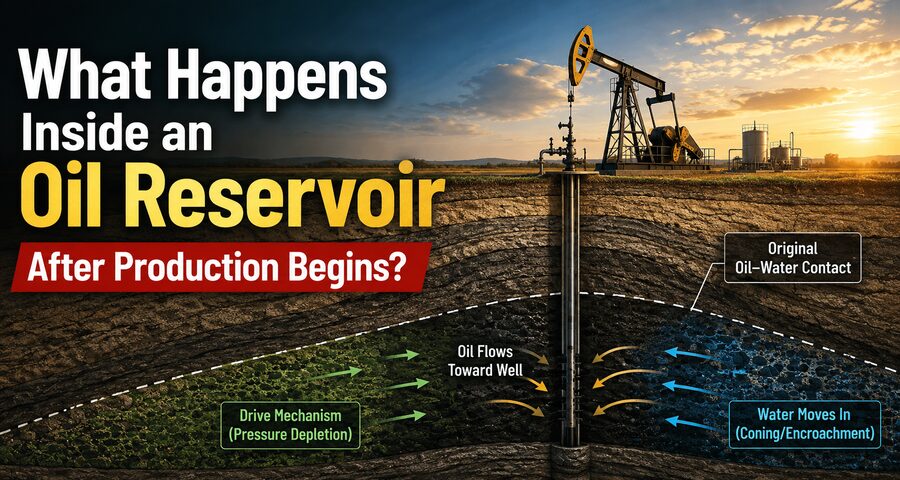
Before production starts, the reservoir has often remained under pressure for millions of years. Once a well is opened, that equilibrium changes. Fluids begin moving toward the wellbore, reservoir pressure starts to decline, dissolved gas may come out of the oil, water may move into the reservoir, and the pattern of oil saturation changes continuously.
Understanding these processes is essential for petroleum engineers because the behavior of the reservoir determines how quickly oil can be produced, how much can ultimately be recovered, and what recovery methods should be used later in the field’s life. 🧪🛢️
🪨 What Is an Oil Reservoir?
An oil reservoir is a subsurface rock formation that contains hydrocarbons trapped beneath impermeable or low-permeability layers.
The reservoir rock must generally have two important properties:
Porosity refers to the percentage of the rock’s volume made up of pore spaces.
Permeability describes how easily fluids can flow through those interconnected pores.
A rock can have high porosity but poor permeability if its pores are not well connected.
Inside the reservoir, the pore spaces may contain a combination of:
- 🛢️ Oil
- 🔥 Natural gas
- 💧 Formation water
These fluids occupy the reservoir in different proportions depending on geology, pressure, and fluid properties.
⚖️ The Reservoir Before Production
Before drilling and production begin, the reservoir is usually close to pressure equilibrium.
Its pressure may be hundreds or even thousands of pounds per square inch, depending on depth and geological conditions.
That pressure is created partly by the weight of overlying rock and fluids, as well as by the physical behavior of the oil, gas, and water trapped underground.
The reservoir also stores energy.
This natural energy is extremely important because it provides much of the force that initially pushes hydrocarbons toward producing wells.
When a well is opened, the pressure near the wellbore becomes lower than the pressure farther inside the reservoir.
That pressure difference becomes the driving force for fluid movement.
🛢️ Oil Starts Flowing Toward the Well
Once production begins, oil does not rush toward the well from the entire reservoir at once.
Instead, a pressure gradient develops.
Pressure is lowest near the producing well and higher farther away.
Oil therefore moves through interconnected pore spaces toward the lower-pressure region.
The ease with which it moves depends on several factors:
- Rock permeability
- Oil viscosity
- Reservoir pressure
- Well pressure
- Fluid saturation
- Geological barriers
- Distance from the well
A highly permeable reservoir containing relatively light oil may produce easily.
A tight reservoir containing very viscous oil may require much more assistance.
📉 Reservoir Pressure Begins to Decline
One of the most important changes after production begins is pressure depletion.
As oil, gas, and sometimes water are removed from the reservoir, the total amount of fluid underground decreases.
Unless another fluid enters or is injected to replace what is produced, reservoir pressure generally falls.
The rate of pressure decline provides engineers with valuable information.
A rapid pressure drop may indicate limited natural pressure support.
A slower decline may suggest that gas expansion, water influx, or another reservoir-drive mechanism is helping maintain pressure.
Engineers continuously monitor pressure because it strongly influences production rate and ultimate oil recovery.
🔥 Dissolved Gas Can Come Out of the Oil
Crude oil often contains natural gas dissolved within it under high reservoir pressure.
This is similar in concept to carbon dioxide dissolved in a sealed bottle of soda.
As long as pressure remains sufficiently high, much of the gas stays dissolved in the oil.
However, as reservoir pressure falls below a specific value called the bubble-point pressure, gas begins to come out of solution.
Small gas bubbles form inside the reservoir pores.
As pressure continues to decrease, these bubbles can grow and connect.
Eventually, gas may begin flowing independently through the reservoir.
This change can dramatically affect oil production. 🔥🛢️
🎈 Solution-Gas Drive
A reservoir in which expanding dissolved gas provides much of the production energy is called a solution-gas-drive reservoir.
As pressure falls, dissolved gas expands.
This expansion helps push oil toward the producing wells.
Initially, this mechanism can provide useful production energy.
But gas is much more mobile than oil.
Once a connected gas phase develops, gas can increasingly flow toward the well while leaving substantial quantities of oil behind.
The gas-to-oil ratio at the surface may therefore rise.
At the same time, reservoir pressure can fall rapidly.
Solution-gas-drive reservoirs often recover only a limited percentage of their original oil without additional recovery methods.
🧢 What Happens If There Is a Gas Cap?
Some reservoirs contain a separate accumulation of natural gas above the oil.
This is called a gas cap.
Because gas is less dense than oil, it naturally tends to occupy the upper portion of the reservoir.
When oil is produced, the gas cap can expand downward.
The expanding gas helps maintain reservoir pressure and pushes oil toward the wells.
This process is called gas-cap drive.
Gas-cap expansion can provide stronger pressure support than solution-gas drive.
However, production must be managed carefully.
If wells produce too much gas directly from the gas-cap region, reservoir energy may be lost inefficiently.
💧 Water Can Move Into the Reservoir
Many oil reservoirs are connected to large underground water-bearing formations called aquifers.
As oil is removed and reservoir pressure decreases, water from the surrounding aquifer may flow into the oil-bearing region.
This process is called water influx.
Water can provide powerful natural pressure support.
In a strong water-drive reservoir, incoming water replaces some of the produced oil and helps maintain reservoir pressure.
This can significantly improve oil recovery.
However, water movement also creates challenges.
Eventually, the advancing water may reach producing wells.
When that happens, the amount of produced water can increase dramatically.
🌊 The Movement of the Oil-Water Contact
In many reservoirs, oil lies above formation water.
The boundary between these fluids is often called the oil-water contact.
During production, if water from an aquifer moves into the reservoir, this contact can rise.
Over time, water may occupy more of the pore space that previously contained movable oil.
The movement is rarely perfectly uniform.
Geological variations can cause water to move faster through some layers than others.
Highly permeable channels can allow water to reach wells quickly, while lower-permeability regions may still contain large quantities of oil.
This uneven movement is one reason reservoir management is so challenging.
🧩 Reservoir Rocks Are Not Uniform
Real reservoirs are highly heterogeneous.
Even within the same field, permeability and porosity can vary substantially.
A reservoir may contain:
- High-permeability sand layers
- Tight rock
- Natural fractures
- Faults
- Shale barriers
- Different rock types
These geological features strongly influence how fluids move.
Oil may flow easily through one part of the formation while remaining trapped in another.
Injected water or gas may also choose the easiest flow paths instead of sweeping uniformly through the reservoir.
As a result, significant oil can remain underground even after many years of production.
🧲 Capillary Forces Hold Some Oil in Place
Not all oil can flow freely toward a well.
At microscopic scales, oil and water interact with rock surfaces through capillary forces.
After water moves through a reservoir, small droplets or pockets of oil may become trapped inside pores.
This oil is called residual oil.
Even when the reservoir still contains large amounts of petroleum, some of it may no longer move under normal pressure gradients.
This is one of the main reasons that producing 100% of the oil originally in place is practically impossible.
🧪 Relative Permeability Changes During Production
When several fluids share the same pore spaces, each fluid’s ability to flow depends partly on how much of that fluid is present.
This behavior is described using relative permeability.
For example, if a pore network contains mostly oil, oil may flow relatively easily.
As water saturation rises, water may become increasingly mobile while oil mobility falls.
Similarly, as gas saturation increases, gas may begin flowing more easily.
Reservoir simulators use relative-permeability relationships to predict how oil, gas, and water will move over time.
🏗️ Rock and Fluid Expansion Can Provide Energy
Oil, water, and reservoir rock are slightly compressible.
When pressure falls, fluids expand slightly and the rock framework can also respond.
This stored compressive energy contributes to production.
In some reservoirs, especially undersaturated oil reservoirs early in their life, rock and fluid expansion may provide part of the driving mechanism before gas begins to separate from the oil.
However, this source of energy is usually limited compared with strong water-drive or gas-cap expansion.
📊 Engineers Use Production Data to Understand What Is Happening
Most of the reservoir cannot be directly observed.
Engineers therefore infer subsurface behavior from measurements.
Important data include:
- Oil production rate
- Gas production rate
- Water production rate
- Reservoir pressure
- Well pressure
- Fluid composition
- Temperature
Changes in these quantities can reveal what is happening underground.
For example, a rapidly increasing gas-oil ratio may indicate gas liberation or gas-cap breakthrough.
A rising water cut may indicate advancing formation water or injected water.
Pressure trends may reveal whether the reservoir has strong natural support.
💧 What Is Water Cut?
Water cut is the fraction of produced liquid that consists of water.
Suppose a well produces 1,000 barrels of total liquid per day, including:
- 700 barrels of water
- 300 barrels of oil
The water cut is:
700 / 1,000 = 70%
As an oil field matures, water cut often increases.
Some older wells may produce far more water than oil.
Handling this water becomes a major operational challenge because it must be separated, treated, reinjected, or disposed of responsibly.
💉 Why Engineers Inject Water
If natural reservoir pressure is not sufficient, operators may inject water through dedicated injection wells.
This technique is called waterflooding.
Water injection serves two major purposes:
- It helps maintain reservoir pressure.
- It physically displaces oil toward producing wells.
Instead of allowing reservoir pressure to collapse, injected water replaces some of the volume of the produced fluids.
This can greatly increase the amount of oil recovered.
Waterflooding is one of the most widely used secondary recovery methods in the petroleum industry.
🔥 Gas Injection Can Also Maintain Pressure
Gas can also be injected into a reservoir.
Possible injected gases include:
- Natural gas
- Nitrogen
- Carbon dioxide
Gas injection can maintain pressure and push oil toward wells.
Under certain pressure and composition conditions, injected gas can become miscible with the oil.
When fluids become miscible, the interface between them largely disappears.
This can reduce the forces trapping oil in the rock and improve recovery.
Carbon dioxide injection is one well-known example.
🧪 Enhanced Oil Recovery
After primary production and conventional water or gas injection, considerable oil may still remain underground.
Engineers may then consider Enhanced Oil Recovery, or EOR.
EOR methods attempt to change the physical properties of the reservoir fluids or the interactions between oil and rock.
Major categories include:
- ♨️ Thermal recovery
- 💨 Gas injection
- 🧪 Chemical flooding
Thermal methods heat heavy oil to reduce its viscosity.
Chemical methods may use polymers or surfactants to improve displacement.
Miscible gas injection can reduce interfacial effects and increase oil mobility.
The appropriate method depends heavily on reservoir geology and fluid properties.
♨️ What Happens to Heavy Oil?
Heavy oil has high viscosity, which means it resists flowing through porous rock.
In some heavy-oil reservoirs, ordinary pressure depletion is not sufficient for economical production.
Engineers may inject steam.
The heat reduces oil viscosity, allowing it to move more easily.
Techniques such as steam flooding and Steam-Assisted Gravity Drainage (SAGD) use heat to mobilize oil.
Inside the reservoir, these methods create changing temperature zones that influence viscosity, density, pressure, and fluid flow.
📉 Production Rate Usually Declines Over Time
Most oil wells do not maintain their initial production rate forever.
Production often declines as:
- Reservoir pressure decreases
- Easily movable oil is depleted
- Water production rises
- Gas production increases
- Remaining oil becomes harder to reach
Engineers analyze these trends using decline-curve analysis and reservoir simulation.
The goal is to estimate future production and determine whether interventions might improve recovery.
💻 Reservoir Simulation Creates a Digital Model Underground
Because engineers cannot see the entire reservoir directly, they build computer models.
A reservoir simulator divides the underground formation into many computational cells.
Each cell can contain estimates of:
- Pressure
- Porosity
- Permeability
- Oil saturation
- Gas saturation
- Water saturation
The simulator calculates how fluids move between cells over time.
Engineers compare simulated production with real field data and adjust the model to improve accuracy.
This process helps them evaluate different strategies before applying them in the real reservoir.
🕳️ New Wells Can Change the Flow Pattern
Drilling an additional production or injection well changes pressure patterns throughout the reservoir.
A new producer creates another low-pressure region toward which fluids can move.
An injector creates a higher-pressure region.
By carefully selecting well locations, engineers try to improve the sweep of oil through the reservoir.
Horizontal wells can contact much larger portions of the reservoir than conventional vertical wells.
Multilateral wells can access several regions from a single main wellbore.
These technologies can improve recovery from complex reservoirs.
⚠️ Water or Gas Can Break Through Early
Sometimes injected water or gas reaches a producing well much sooner than expected.
This is called breakthrough.
Early breakthrough can happen when a reservoir contains high-permeability channels or fractures.
Instead of sweeping oil evenly, the injected fluid takes the easiest route.
The producing well may then begin producing large amounts of water or gas while significant oil remains elsewhere.
Engineers may respond by modifying injection patterns, reducing certain well rates, or using treatments designed to block unwanted flow paths.
📉 Reservoir Compaction and Surface Subsidence
In some reservoirs, lowering pressure can cause the rock itself to compact.
As pore pressure falls, more of the overlying geological load is carried by the rock framework.
This can reduce pore volume.
In extreme cases, reservoir compaction can contribute to surface subsidence, where the land above the reservoir slowly sinks.
This effect has been observed in some oil and gas fields.
Compaction can sometimes provide additional energy that helps push fluids toward wells, but excessive deformation can create significant engineering and environmental challenges.
🌡️ Temperature Usually Changes Less Than Pressure
Pressure can change dramatically during production, while the overall reservoir temperature often remains relatively stable in conventional reservoirs.
However, local temperature effects can occur because of fluid expansion, injected fluids, or chemical processes.
Thermal recovery is an important exception.
When steam is injected into a heavy-oil reservoir, reservoir temperatures can change substantially.
Engineers must then model heat transfer in addition to ordinary fluid flow.
🧭 Gravity Continues to Separate Fluids
Gravity remains important throughout reservoir production.
Because gas is less dense than oil, it tends to move upward.
Water, being generally denser than oil, tends to move downward.
These forces can produce gravity segregation.
In thick reservoirs, gravity can sometimes improve displacement efficiency by helping maintain separate fluid zones.
In other cases, it can cause injected gas to rise too quickly and bypass oil lower in the formation.
Reservoir engineers account for gravity when designing well placement and injection strategies.
🛢️ How Much Oil Can Actually Be Recovered?
The amount of oil initially present in a reservoir is often called Original Oil in Place, or OOIP.
Only a fraction of that oil can normally be produced economically.
The percentage recovered is called the recovery factor.
Recovery depends on many factors, including:
- Reservoir pressure
- Rock permeability
- Oil viscosity
- Natural drive mechanism
- Well placement
- Reservoir heterogeneity
- Secondary recovery
- Enhanced oil recovery
Some reservoirs have relatively low recovery factors, while favorable reservoirs using advanced recovery methods can recover much larger fractions.
The remaining oil may be physically trapped, located in poorly connected zones, or simply too expensive to produce.
🌍 Why Understanding Reservoir Behavior Matters
Reservoir management is not just about maximizing short-term production.
Producing too aggressively can sometimes reduce long-term recovery.
For example, excessive pressure depletion may cause gas to come out of solution too rapidly.
Poorly designed water injection can create premature water breakthrough.
Improper gas-cap production can waste valuable reservoir energy.
Engineers therefore try to balance current production with long-term reservoir performance.
This requires cooperation among petroleum engineers, geologists, geophysicists, drilling specialists, and production engineers.
🌟 Final Thoughts
When oil production begins, an underground reservoir enters a constantly changing state.
The pressure around producing wells falls, causing oil to move through microscopic pores toward the wellbores. As pressure declines, dissolved natural gas may come out of solution and expand. Gas caps may move downward, while water from surrounding aquifers can move upward or inward.
At the same time, the proportions of oil, gas, and water inside the rock change. Their relative ability to flow also changes. Some oil becomes trapped by capillary forces, while other oil remains in low-permeability zones that are difficult to reach.
Engineers respond by monitoring pressures and production rates, drilling additional wells, and injecting water or gas to maintain reservoir energy. Later, enhanced recovery technologies may be used to mobilize additional oil. 🛢️💧
What happens underground is therefore much more complicated than simply “emptying” an oil reservoir.
The reservoir behaves like a giant, three-dimensional fluid-flow system in which pressure, geology, chemistry, gravity, capillary forces, and engineering decisions all interact.
By understanding and managing those interactions, engineers can recover more oil using fewer wells, reduce unnecessary water and gas production, protect reservoir pressure, and extend the productive life of an oil field.
The production of oil is visible at the surface, but the real story unfolds kilometers underground, where fluids continuously rearrange themselves inside tiny rock pores as the reservoir responds to every barrel removed. 🌍🪨🛢️⚙️