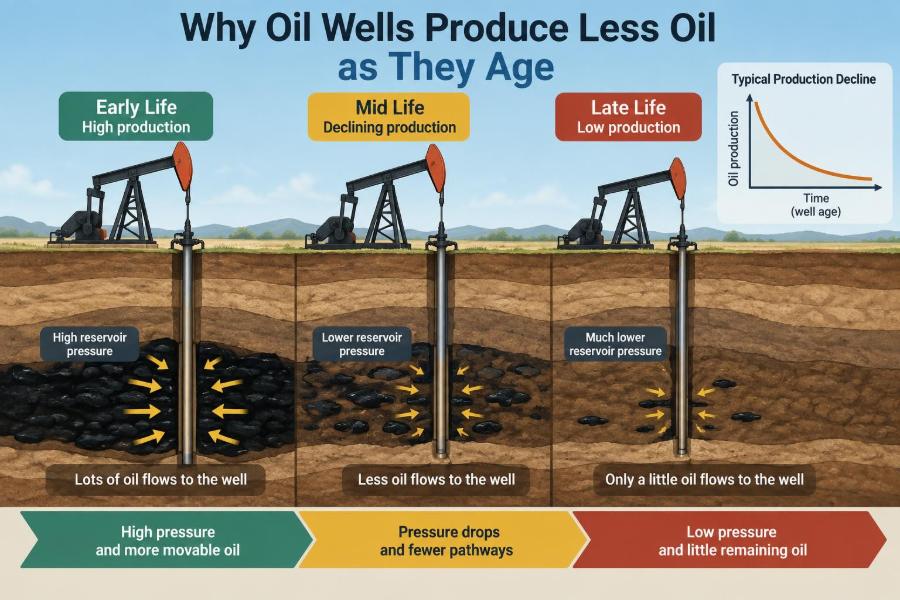

A producing oil well can look deceptively simple at the surface: a wellhead, flowlines, tanks, and perhaps a pump moving steadily up and down. Yet the amount of oil reaching that surface equipment is controlled by a changing system thousands of metres underground.
Early in a field’s life, a well may flow strongly because the reservoir has enough pressure to push fluids toward the borehole and up the tubing. Years later, the same well may produce more water, more gas, or simply less total liquid, even when its surface equipment is operating normally.
This decline matters well beyond a production forecast. It affects artificial-lift choices, facility capacity, operating cost, recovery planning, reserves estimates, and the decision to invest in interventions or eventually abandon the well.
Most importantly, declining oil rate is not one single problem with one universal fix. It is the visible result of reservoir depletion, fluid movement, rock behavior, wellbore restrictions, and operating constraints acting together.
🧭 The Short Answer: Energy and Access Change
Oil wells generally produce less oil as they age because the energy that drives fluids through the reservoir declines, while the pathways that favor oil production often become less effective. At the same time, water and gas can increasingly compete with oil for flow capacity.
A well does not “run out” of oil in a simple tank-like sense. Significant oil may remain in the reservoir, but it can be difficult to move economically toward the wellbore.
🪨 A Reservoir Is Rock, Not an Underground Lake
Reservoirs are porous rocks containing microscopic connected spaces called pores. Oil, water, and often gas occupy those pore spaces, while permeability describes how readily fluids can move through the rock.
Think of a reservoir less like a cavern full of liquid and more like a very large, fluid-filled sponge made of sandstone or carbonate. Producing a well creates a lower-pressure point that encourages fluids to move through the connected pore network.
📉 Pressure Depletion Is the Main Long-Term Driver
As hydrocarbons and associated fluids are produced, average reservoir pressure usually falls unless pressure is actively supported. The pressure difference between the reservoir and the flowing wellbore—often called drawdown—is a major driver of production.
With lower reservoir pressure, the same rock and completion may deliver less fluid to the well. A drop in oil rate can therefore be a normal physical response to depletion rather than proof of equipment failure.
⚙️ Natural Flow Has a Limited Life
In a naturally flowing well, reservoir pressure must overcome friction in the reservoir, perforations, tubing, valves, flowlines, and surface equipment, while also lifting fluid against gravity.
Early on, this energy balance may be favorable. As pressure declines or fluid density rises because of increasing water production, the well may no longer have enough energy to sustain stable flow. This is one reason artificial lift becomes necessary in many mature wells.
💧 Water Often Takes Up More of the Produced Stream
Most oil reservoirs contain water naturally. Over time, the fraction of produced liquid that is water—called water cut—often rises as water moves toward producing wells.
A rising water cut does not necessarily mean the well is producing more total fluid. It means a larger share of the produced liquid is water and a smaller share is oil. A well can maintain a respectable liquid rate while its oil rate falls sharply.
🌊 Water Encroachment Changes the Flow Path
Many reservoirs are supported partly by an aquifer, a connected body of formation water. As pressure declines, this water can move inward and replace produced fluids, helping maintain pressure but also advancing toward perforated intervals.
That support is a trade-off. Water influx may prolong production, but once water finds an efficient route to the well, it can reduce oil relative permeability and impose larger lifting and disposal demands.
🧱 Relative Permeability Explains Why Fluids Compete
When only one fluid occupies a rock, flow behavior is comparatively straightforward. In most producing reservoirs, however, oil, water, and gas share the pore space, and each fluid reduces the effective flow capacity available to the others.
Relative permeability describes this multiphase-flow effect. As water saturation rises near a well, water may flow more easily while oil flows less easily, even though oil remains present in the rock.
🫧 Gas Coming Out of Solution Can Help and Hurt
Some crude oils contain dissolved gas at reservoir conditions. When pressure drops below the bubble-point pressure, gas begins to evolve from the oil and forms a separate phase.
Initially, expanding gas can contribute useful energy. Later, free gas can reduce oil mobility near the wellbore, create unstable flow, and lower pump efficiency. The result depends on fluid properties, reservoir geometry, depletion rate, and the production system.
🔀 Gas Coning and Water Coning Can Accelerate Decline
If a well is completed near a gas cap or an oil-water contact, strong drawdown can pull gas downward or water upward toward the perforations. These localized movements are known as gas coning and water coning.
Imagine drawing liquid through a straw placed near the boundary between two liquids. Pulling too hard can distort the interface toward the intake. In a reservoir, this can cause early gas or water breakthrough and reduce oil productivity.
🕳️ The Drainage Area Does Not Empty Uniformly
A well drains the portions of a reservoir that communicate effectively with it. High-permeability layers and fractures may deliver fluid quickly, while tighter zones respond slowly or remain poorly connected.
As the most accessible oil is produced, the remaining oil may lie in lower-permeability rock, isolated compartments, or zones bypassed by the dominant flow paths. That is why a falling rate does not directly reveal the total oil remaining.
🧩 Reservoir Heterogeneity Makes Every Well Different
Real formations are rarely uniform. Variations in grain size, fractures, shale barriers, faults, bed thickness, and permeability create different flow behavior between wells drilled into the same field.
One well may decline smoothly, while a nearby well sees early water breakthrough or a sudden productivity loss. Field-wide averages are useful, but individual-well decisions require local data and an understanding of the specific completion.
🧪 Viscous Oil Moves More Slowly
Viscosity is a fluid’s resistance to flow. Light oil generally moves more readily through porous rock than heavy, viscous oil under comparable conditions.
As pressure and temperature conditions change, or as water and gas alter the near-wellbore flow environment, viscous oil can become increasingly difficult to mobilize. Heavy-oil operations may need thermal methods, specialized lift, or other approaches that conventional production does not require.
🧂 Scale Can Restrict a Well From the Inside
Scale is a mineral deposit that can form when produced-water chemistry changes as pressure, temperature, or dissolved gas content changes. It may accumulate in perforations, tubing, pumps, valves, and flowlines.
Even a modest restriction increases pressure loss. If less pressure reaches the reservoir face, inflow declines; if lifting equipment is restricted, fluid may not reach the surface efficiently. Chemical treatment can help, but the appropriate method depends on the scale type and location.
🕯️ Wax and Asphaltenes Can Reduce Flow Assurance
Some crude oils contain waxes that precipitate as fluid cools, especially in tubing and flowlines. Asphaltenes, a heavier fraction of crude, can also deposit when pressure and fluid composition change.
These deposits do not always explain reservoir decline, but they can mimic it at the surface. A production engineer must separate a reservoir-delivery problem from a transport problem before choosing a remedy.
🏗️ Formation Damage Reduces Near-Wellbore Productivity
The rock immediately around the wellbore has an outsized influence on production. Drilling fluids, fines migration, clay swelling, scale, emulsions, and incompatible injected fluids can impair this zone, creating formation damage.
Engineers often represent the extra resistance as skin. Positive skin indicates impaired flow near the well; reducing it through a carefully designed stimulation can improve productivity, though it cannot restore reservoir pressure or solve every decline mechanism.
🧯 Sand Production Creates Both Surface and Subsurface Problems
Weak or unconsolidated formations may produce sand along with oil, gas, and water. Sand can erode equipment, fill perforations, damage pumps, and force operators to lower the rate to avoid unsafe or uneconomic conditions.
Sand-control completions, screens, gravel packs, and rate management may be used where appropriate. The trade-off is that sand control can introduce additional flow resistance, so design must balance containment and productivity.
🔩 Completion Design Determines What the Well Can Reach
Perforations connect the wellbore to the reservoir. Their placement, density, orientation, and condition affect which layers contribute fluids and whether the well preferentially produces oil, water, or gas.
A completion that initially performs well may become less selective as fluid contacts move. Reperforating, isolating a watered-out interval, or using zonal-control equipment can sometimes redirect production—but only if reservoir and mechanical conditions support the plan.
⬇️ Wellbore Loading Can Stop a Gas Well—and Affect Oil Wells Too
In wells producing significant gas, liquid can accumulate when gas velocity is no longer high enough to carry it to surface. This is called liquid loading. The accumulated liquid increases hydrostatic pressure and can suppress production further.
Oil wells with gas lift or high gas fractions also face complex multiphase-flow behavior. A decline in rate may involve the tubing and flowline system as much as the reservoir itself.
🤖 Artificial Lift Extends Production but Does Not Create Reservoir Energy
Artificial lift reduces the flowing pressure at the wellbore or helps raise fluids to surface. Common systems include beam pumping, electric submersible pumps, progressive cavity pumps, gas lift, and hydraulic lift.
The crucial distinction is that artificial lift can improve the well’s ability to use available reservoir energy. It does not, by itself, increase the volume of movable oil in the reservoir.
⚖️ Matching Lift to the Well
- Beam pumps are widely used for moderate liquid rates and can be practical in many onshore settings.
- Electric submersible pumps can handle high liquid volumes but are sensitive to gas handling, solids, and operating conditions.
- Gas lift can suit deviated wells and changing rates, provided suitable gas supply and infrastructure exist.
- Progressive cavity pumps are often useful with viscous fluids and solids but have operating limits depending on temperature and well conditions.
📈 A Production Decline Curve Is Evidence, Not a Diagnosis
Production engineers use decline-curve analysis to describe how a well’s rate changes over time and to support forecasting. Common mathematical forms include exponential, hyperbolic, and harmonic declines.
A decline curve is valuable, but it does not identify the physical cause on its own. A sharp deviation from trend could reflect water breakthrough, a pump failure, a choke change, downtime, workover activity, or a genuine reservoir shift.
🧭 Production Surveillance Finds the Real Constraint
Good decisions start with surveillance: production rates, water cut, gas-oil ratio, flowing pressures, fluid levels, pump performance, well tests, and sometimes downhole measurements. The goal is to identify where pressure is being lost and what phase is causing the limitation.
For example, falling oil rate with stable liquid rate and rising water cut suggests a different problem from falling liquid rate, falling pressure, and stable water cut. Those patterns point toward different diagnostic workflows.
🧰 Workovers Can Restore Access, Not Rewrite Physics
A workover is a substantial well intervention intended to repair, modify, or improve a well. It might replace failed tubing, remove scale, repair a pump, isolate water-producing intervals, or recomplete an untapped zone.
Workovers can be highly effective when a specific, correctable restriction is identified. They are less likely to succeed when the underlying issue is broadly depleted pressure, poor reservoir connectivity, or unfavorable fluid mobility.
💥 Stimulation Can Improve Inflow When Damage or Tight Rock Is the Limit
Acidizing can dissolve certain materials or alter flow pathways in suitable formations, while hydraulic fracturing creates conductive fractures to connect the wellbore with more reservoir rock. Neither treatment should be treated as a universal “production booster.”
A stimulation must be matched to rock type, fluid compatibility, mechanical containment, and the actual source of poor productivity. In a water-prone setting, a poorly targeted treatment may increase unwanted-water production along with oil.
💉 Waterflooding Replaces Energy and Sweeps Oil
Water injection is a secondary-recovery method used to maintain pressure and displace oil toward producing wells. It is often implemented across a pattern of injectors and producers rather than as an isolated well treatment.
Its performance depends heavily on sweep efficiency: whether injected water contacts and displaces oil across the reservoir rather than racing through high-permeability streaks. Injection can extend field life, but it also requires water handling, compatibility management, and vigilant surveillance.
🧬 Enhanced Oil Recovery Targets Oil Left Behind
Enhanced oil recovery, or EOR, includes methods designed to improve displacement beyond conventional depletion and waterflooding. Depending on the reservoir, approaches may involve gas injection, chemical formulations, or thermal processes.
These methods can change fluid properties, pressure behavior, or displacement efficiency, but their applicability is highly reservoir-specific. Screening, laboratory work, simulation, pilot testing, infrastructure, economics, and environmental controls all shape whether an EOR project is viable.
💰 Economics Can End Production Before the Reservoir Is Empty
A well is not kept online solely because it can produce some oil. Revenue must cover operating expenses, water handling, lift power or fuel, chemicals, repairs, emissions requirements, and other field costs.
As water cut rises, each barrel of oil may require lifting and treating many barrels of water. A well can therefore reach its economic limit even though recoverable oil remains underground.
⚠️ Common Misreadings of an Aging Well
Several assumptions can lead to expensive or ineffective responses:
- “The well is dry.” Lower rate often means reduced mobility or energy, not zero remaining oil.
- “More drawdown always means more oil.” Excess drawdown can promote coning, sanding, gas interference, or pump problems.
- “A larger pump will fix it.” Oversizing lift can lower intake pressure too far, cause gas interference, or exceed reservoir inflow.
- “Water production means the well has failed.” Water may be expected in mature production, though its source and cost still need evaluation.
- “One successful offset treatment will work here.” Nearby wells may have different layers, contacts, completion histories, and mechanical conditions.
🧑🔧 A Practical Diagnostic Sequence
Before changing equipment or approving an intervention, engineers generally work from the broad production system toward the specific restriction. This avoids treating symptoms while missing the actual cause.
- Verify measurements, allocation, downtime records, and recent operating changes.
- Review oil, water, gas, pressure, and fluid-level trends together rather than in isolation.
- Check surface constraints, flowline pressure, choke settings, separation performance, and lift operation.
- Assess mechanical integrity, scale, solids, tubing condition, and pump behavior.
- Use reservoir and completion data to evaluate depletion, coning, crossflow, zonal contribution, or bypassed pay.
- Estimate technical benefit, risk, and economics before selecting a workover, lift change, stimulation, or shut-in.
🔍 Uncertainty Should Shape Decisions
Subsurface information is incomplete by nature. Pressure data may be sparse, logs may not resolve every thin layer, and production allocation can be uncertain in commingled systems.
A sound plan states what is known, what is inferred, and what measurement would most reduce uncertainty. In some cases, a relatively small diagnostic test prevents a costly intervention based on the wrong mechanism.
🌱 Mature-Well Management Includes Environmental Responsibility
Declining oil production often coincides with higher water volumes, aging equipment, and more frequent interventions. That raises practical needs for produced-water management, corrosion control, leak detection, emissions management, and eventual plugging and abandonment.
Extending a well’s productive life should not mean deferring integrity work. Safe, compliant operations require attention to the whole system, including wells, flowlines, tanks, disposal or injection facilities, and final closure obligations.
🧠 The Core Principle: Decline Is a System Problem
An aging well produces less oil when the reservoir supplies less usable energy, oil has a harder time moving through the rock, unwanted fluids gain easier access to the well, or the wellbore and surface system add resistance. Often, several of these occur at once.
The best response is not automatically more pumping, more drawdown, or more stimulation. It is a diagnosis that connects reservoir behavior, completion performance, artificial lift, flow assurance, and economics into one coherent explanation.
Oil wells usually decline not because oil simply disappears, but because producing the remaining oil becomes progressively harder to drive, flow, lift, and manage economically. Understanding which part of that chain is limiting the well is the foundation of sound petroleum engineering. 🛢️📉🔧