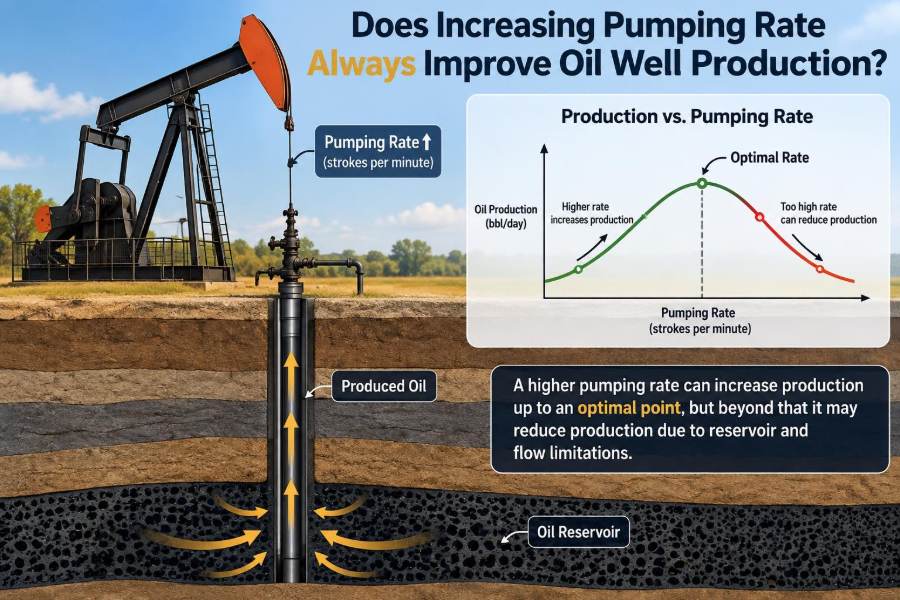

A producing well slows down, and the first instinct is understandable: increase the pumping rate. If the pump lifts more fluid every day, surely the well will deliver more oil.
Sometimes that decision works. A well with available inflow capacity and a fluid level safely above the pump may respond with a meaningful oil-rate increase. But many wells are already constrained by the reservoir, the completion, the pump, or the surface system.
In those cases, turning a pump faster can lift more water, create damaging flow conditions, shorten equipment life, or even reduce oil production after a brief improvement. The well may look more active while becoming less efficient.
Understanding the difference between lifting capacity and well deliverability is essential for anyone involved in artificial lift, production surveillance, or field operations.
🧭 The Short Answer: Not Necessarily
Increasing pumping rate does not automatically improve oil well production. It improves production only when the well can supply additional fluid and the entire production system can handle that fluid safely and economically.
A pump does not create reservoir energy or oil in place. Its practical role is to lower flowing bottomhole pressure, allowing reservoir fluids to enter the wellbore, and then lift those fluids to surface.
If a lower pressure at the sandface stimulates useful additional inflow, more pumping may help. If inflow cannot increase, the pump simply removes liquid faster than the well can replace it.
🛢️ Separate Oil Rate from Total Liquid Rate
The phrase “production increase” can be misleading. A higher pumping rate often raises total liquid rate, which is the combined volume of oil and water produced. That is not the same as raising the oil rate.
In a mature water-producing well, an increase in liquid throughput may be dominated by water. The operator then pays to lift, separate, treat, and dispose of more water without obtaining much more saleable oil.
Production decisions should therefore review oil, water, gas, and total-fluid trends together. Looking only at gross fluid can make an uneconomic change appear successful.
📉 Reservoir Inflow Sets the First Limit
Every reservoir and completion has a finite ability to deliver fluids to a well. This relationship is commonly described by an inflow performance relationship, or IPR, which connects production rate with flowing bottomhole pressure.
As bottomhole pressure falls, the pressure difference between the reservoir and the well increases. This pressure difference, called drawdown, usually encourages more fluid to flow toward the well.
However, the relationship is not unlimited or perfectly linear. At sufficiently low pressure, extra drawdown may produce only a small additional fluid rate, particularly in low-permeability formations or damaged completions.
📊 What Drawdown Actually Does
Drawdown is the difference between average reservoir pressure and flowing bottomhole pressure. It is the driving force that moves hydrocarbons and formation water through porous rock into the well.
Lowering bottomhole pressure can be productive when the reservoir still has mobile oil near the wellbore. Yet aggressive drawdown can also mobilize unwanted water or gas, destabilize weak formations, and increase the pressure losses that limit flow.
The operational question is not “Can we draw the well down further?” It is “What incremental oil will the added drawdown provide, and what consequences accompany it?”
🔄 The Operating Point Must Match Inflow and Lift
A producing well operates where two capabilities meet. The reservoir-completion system supplies fluid according to its IPR, while the wellbore and artificial-lift system impose an outflow requirement, often represented by tubing performance.
The intersection of those two relationships is the operating point. Changing pump speed, stroke length, gas lift injection, or tubing conditions can shift the outflow side and create a new operating point.
A favorable shift lowers bottomhole pressure enough to increase inflow. An unfavorable one reaches a physical constraint before more oil can arrive at surface.
🧮 Why More Pumping Can Hit a Plateau
Imagine a well whose pump can lift 500 barrels of liquid per day, while the reservoir can sustainably provide only 350. Increasing pump capacity toward 700 barrels per day does not make 700 barrels appear.
Instead, the fluid level in the wellbore may fall. Once the liquid level approaches the pump intake, the pump has less submergence, meaning less liquid head above it to support stable operation.
At that point, the well is pump-off constrained, not pump-capacity constrained. More speed may cause poor pump fillage rather than more production.
⚙️ Pump Fillage Reveals Whether the Pump Is Starved
For a rod-pumped well, pump fillage describes how completely the downhole pump barrel fills with liquid during a pumping cycle. High fillage generally suggests the pump is receiving adequate fluid, although other diagnostics are still needed.
Low fillage can indicate insufficient inflow, gas interference, fluid pound, or a pump malfunction. It should not be assumed to mean that the pump needs to run faster.
Dynamometer cards, fluid-level measurements, production tests, and pump-off controller data help distinguish these causes. The correct response to poor fillage depends on the diagnosis.
🔨 Fluid Pound Is a Warning, Not Extra Capacity
Fluid pound occurs when a reciprocating pump does not contain enough liquid to cushion the plunger motion near the end of the stroke. The result can be a sharp mechanical impact and a distinctive surface-card pattern.
Repeated pounding transmits loads through rods, tubing, the pump, and surface equipment. It can contribute to rod failures, pump wear, tubing leaks, and avoidable downtime.
Speeding up a starved rod pump often makes this condition worse. A pump-off controller or lower pumping speed may protect equipment while engineers investigate the inflow limitation.
💨 Gas Interference Changes Pump Behavior
Free gas entering a pump occupies volume that liquid would otherwise fill. Because gas is compressible, part of the pump stroke may compress and expand gas instead of displacing produced liquid.
Gas interference is especially relevant when bottomhole pressure falls below the bubble-point pressure of the oil. Gas can come out of solution near the wellbore and at the pump intake.
A faster pump can sometimes increase gas-handling difficulty by lowering intake pressure further. Gas separators, gas anchors, pump placement, and operating conditions may matter more than speed alone.
🌊 Water Coning Can Turn an Oil Gain into a Water Problem
In some reservoirs, water lies below the oil zone. Strong drawdown around a producing well can pull the oil-water contact upward locally toward perforations, a process commonly called water coning.
Once water reaches the completion, the well may experience a rising water cut: a larger fraction of produced liquid is water. The exact behavior depends on reservoir geometry, permeability distribution, fluid mobility, and completion design.
Reducing drawdown does not always reverse an established water problem. This is why production changes should be tested carefully and interpreted alongside water-rate trends.
🔥 Gas Coning and Gas Breakthrough Have Similar Logic
Where a gas cap or mobile gas zone is near the completion, excessive drawdown can encourage gas movement toward the well. High gas production can reduce liquid-pumping efficiency and create constraints in separators, compressors, and flowlines.
Gas breakthrough can also alter the produced gas-oil ratio and lower the pressure available for stable liquid flow. The well may appear to have a higher total production stream while delivering less stable oil output.
Completion interval selection and controlled drawdown are often more effective tools than simply adding lift capacity.
🪨 Near-Wellbore Damage May Be the Real Bottleneck
A low production rate is not always caused by inadequate artificial lift. Scale, fines migration, drilling or completion damage, organic deposits, perforation plugging, and other restrictions can reduce flow near the wellbore.
In this situation, increasing pump rate may lower fluid level but cannot efficiently pull fluid through the restriction. The well behaves as though the reservoir is weak even when pressure support farther from the well remains adequate.
Pressure-transient analysis, production history, well tests, and intervention records can help identify whether a skin effect or mechanical restriction is limiting inflow.
🧪 Stimulation Is Not a Substitute for Diagnosis
If near-wellbore damage is confirmed, an appropriately designed cleanup, acid treatment, solvent treatment, reperforation, or other intervention may improve productivity. The correct option depends on rock type, fluids, damage mechanism, and completion details.
But stimulation is not a universal response to declining production. Applying it without understanding the source of the restriction can waste money or introduce new risks.
Likewise, increasing pump speed before evaluating the well can hide the underlying problem. Both lift changes and remedial work should be based on evidence, not habit.
🧵 Tubing Size Creates Its Own Trade-Off
Fluid moving up tubing loses pressure through friction, and friction losses generally increase as flow rate rises. Small tubing can become restrictive at high liquid rates, limiting how much benefit additional pumping can provide.
Very large tubing is not automatically ideal either. At low rates, liquid velocity may be insufficient for stable multiphase flow in some wells, allowing gas and liquid to behave unpredictably.
Tubing design should consider anticipated liquid rate, gas fraction, depth, pressure, corrosion allowance, scale risk, and the selected artificial-lift method.
🚧 Surface Facilities Can Become the Constraint
The well is only one part of the production system. Flowlines, separators, heaters, tanks, water-handling equipment, injection pumps, and export systems all have operating limits.
Raising a well’s liquid rate can increase line pressure, overwhelm separation performance, cause tank upsets, or exceed water-disposal capacity. These effects may reduce uptime for several wells, not just the one being adjusted.
Before changing pump rate, operators should confirm that the downstream system has enough capacity and that the added fluids can be handled safely.
⚡ Pumping Faster Raises Energy and Maintenance Costs
Artificial lift consumes energy and subjects equipment to cyclic or continuous mechanical duty. A higher speed or larger displacement can increase power demand, rod loading, motor temperature, gearbox stress, and wear on moving parts.
The right economic measure is not the highest gross rate. It is the value of incremental oil after accounting for additional electricity or fuel, workover risk, chemical use, water handling, and lost production from failures.
A modestly lower pumping rate can be the better operating point when it maintains stable production and longer run life.
🪝 Rod-Pumped Wells Need Load Awareness
In sucker-rod pumping, increasing strokes per minute or stroke length raises displacement, but it also changes rod-string dynamics. Accelerations and peak loads can increase substantially, especially in deeper wells.
Rod design, pump size, fluid level, tubing friction, deviation, and surface-unit capability all influence whether a faster setting is mechanically acceptable. A change that appears small at surface can have larger downhole consequences.
Design software and dynamometer interpretation are valuable because they connect pumping settings to loads, stress, and expected downhole behavior.
🔌 ESPs Have Different Limits, Not No Limits
Electrical submersible pumps, or ESPs, can move large liquid volumes, making them useful in high-rate applications. Their performance is governed by pump curves, motor capacity, intake conditions, gas handling, fluid properties, and system head.
Operating too far from the pump’s efficient range can promote vibration, recirculation, overheating, thrust problems, or unstable operation. More frequency from a variable-speed drive does not guarantee a better system match.
Engineers should review intake pressure, motor load, vibration where available, produced fluid changes, and the predicted operating point before increasing speed.
💉 Gas Lift Depends on Injection and Well Response
Gas lift reduces the density of fluid in the tubing by injecting gas at depth. Increasing injection gas can lower hydrostatic pressure and improve production up to an optimum point.
Beyond that point, excess injected gas can add friction, reduce valve efficiency, consume limited compressor capacity, or destabilize flow. The response is governed by well geometry, valve design, injection depth, produced gas, and available pressure.
For a gas-lifted well, the equivalent question is not simply “more injection?” but “what injection rate gives the best oil response for the field?”
🌀 Progressive Cavity Pumps Face Fluid and Solids Limits
Progressive cavity pumps are often selected for viscous oil, sand production, or certain heavy-oil applications. Their displacement rises with rotational speed, but practical performance is limited by torque, elastomer compatibility, temperature, abrasives, gas, and drive capability.
Increasing speed may accelerate wear when produced sand is present or when the pump is poorly lubricated by the fluid. It can also increase torque beyond the safe range of the rod string or drive.
A rate adjustment should therefore consider pump torque trends and fluid characteristics, not only surface RPM.
🧂 Scale, Corrosion, and Emulsions Can Worsen at Higher Rates
Changing production rate changes pressure, temperature, shear, residence time, and fluid mixing. Those shifts can influence scale deposition, corrosion tendencies, wax behavior, and emulsion stability.
For example, increased water throughput may raise the volume of corrosive or scale-forming water contacting tubulars and surface equipment. Stronger shear through pumps and chokes can sometimes create tighter emulsions that are harder to separate.
These outcomes are site-specific, so chemical programs and fluid monitoring should accompany major operating changes.
📈 Production Surveillance Turns a Change into a Test
A pumping-rate adjustment should be treated as a controlled production test rather than a permanent assumption. Establish a baseline first: oil, water, gas, fluid level or intake pressure, equipment loads, wellhead pressures, power use, and relevant facility conditions.
After the change, compare trends over enough time to distinguish a sustained response from a short-lived unloading effect. A brief spike can occur as stored wellbore fluid is removed, even if reservoir inflow has not improved.
Clear acceptance criteria help. For example, an operator might require sustained incremental oil without unacceptable water increase, equipment instability, or facility impact.
🧾 A Practical Pre-Change Checklist
Before increasing a pumping rate, gather the information needed to identify the likely constraint. The amount of data available varies by field, but the decision should be more structured than “the well looks slow.”
- Review recent oil, water, gas, and total-liquid production trends.
- Check fluid level, pump intake pressure, or other evidence of pump submergence.
- Evaluate pump fillage, loads, motor current, torque, vibration, or controller history as applicable.
- Confirm tubing, flowline, separator, water-treatment, and disposal capacity.
- Consider reservoir pressure, water or gas proximity, completion history, and evidence of damage.
- Define a safe test range, monitoring plan, and conditions that require reversal.
🧠 Interpret Short-Term Gains Carefully
Suppose a hypothetical rod-pumped well is sped up and liquid rate rises immediately. That result alone does not prove the reservoir is supporting the new rate.
The pump may initially remove fluid stored in the casing annulus, causing fluid level to fall. If the liquid level continues downward and fillage declines, the apparent gain may fade once stored fluid is depleted.
A sustainable improvement is supported by stable or acceptable fluid-level behavior, consistent equipment performance, and a continuing oil-rate benefit rather than merely a short-term liquid surge.
💰 Optimize for Value, Not Maximum Throughput
The most profitable operating point is often below the maximum rate a pump can mechanically achieve. It balances revenue from incremental oil against lifting cost, produced-water cost, chemical demand, equipment wear, and the probability of intervention.
This perspective matters especially in late-life fields, where water handling may dominate operating effort. Increasing gross production can reduce net value if the incremental stream is mostly water.
Economic limits are also dynamic. Fluid prices, disposal constraints, electricity cost, equipment availability, and facility bottlenecks can change which pumping strategy makes sense.
🛡️ Safety and Operating Discipline Still Come First
Rate changes can alter pressures, loads, tank levels, chemical injection needs, and the behavior of rotating equipment. They should follow the site’s operating procedures, management-of-change process, and applicable safety controls.
Field personnel need clear communication about new setpoints, alarm limits, expected behavior, and escalation triggers. An unexplained pressure increase or unstable pumping condition should be investigated, not normalized.
No production target justifies operating equipment outside established mechanical, process, or environmental limits.
👥 Reservoir, Production, and Facilities Teams Need One Picture
Reservoir engineers focus on pressure support, fluid movement, and well deliverability. Production engineers assess artificial lift and wellbore performance, while facilities teams manage what happens after the fluid reaches surface.
A pump-rate decision is strongest when these views are combined. A reservoir-led concern about coning, a production-led concern about gas interference, and a facilities-led water constraint may all apply to the same well.
Shared data and a common production-system model reduce the risk of optimizing one component while harming the larger asset.
🧭 The Core Principle: Match Lift to the Well
Artificial lift should be matched to what the reservoir and completion can deliver, not pushed beyond it. The best setting creates enough drawdown to capture economic oil while preserving stable pump operation and manageable water, gas, and facility loads.
That setting can change over a well’s life. As reservoir pressure declines, water cut rises, gas behavior changes, or equipment ages, the former optimum may no longer be appropriate.
Increasing pumping rate improves oil production only when additional, economically valuable oil can enter the well and move through the entire system without creating larger technical or financial losses.
The productive question is never simply “Can the pump go faster?” It is “What is limiting this well, and does a higher rate solve that constraint?” Answering that question turns artificial lift from a speed-setting exercise into disciplined production optimization. 🛢️📈🔧