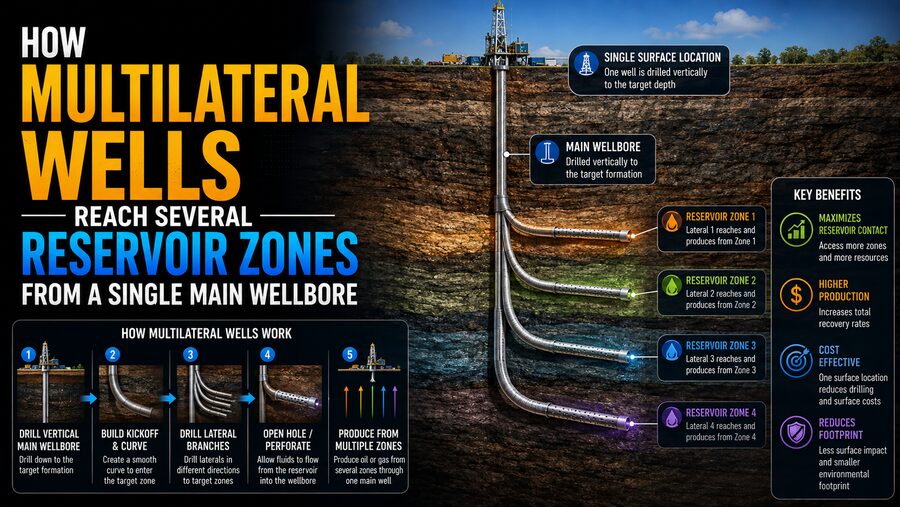

Oil and gas reservoirs are rarely simple underground pools. They may consist of multiple layers, compartments, fractures, or separate productive zones distributed across a large underground area. Reaching each zone with a completely separate well can be technically possible, but it can also require additional drilling, wellheads, surface equipment, and cost.
A multilateral well offers another approach. 🛠️
Instead of drilling one wellbore to one target, engineers create a main wellbore and then branch additional wellbores—called laterals—from it. These branches can extend into different parts of the same reservoir or into separate reservoir zones.
In effect, a multilateral well resembles an underground tree:
One main trunk → several branches → multiple reservoir targets. 🌳
This architecture can increase reservoir contact, reduce the number of surface locations required, and improve access to complex or compartmentalized formations.
🔍 What Is a Multilateral Well?
A multilateral well is a well with two or more wellbore branches connected to a common parent wellbore.
The main well is drilled first. Then one or more laterals are created from selected points along it.
Depending on the reservoir, these branches may be:
- Horizontal
- Deviated
- Inclined
- Curved
- Oriented in different directions
Each lateral can target a specific reservoir section.
For example, a single main well might have:
- One lateral in an upper oil-bearing layer
- Another in a deeper productive interval
- A third extending horizontally through a thin reservoir section
Instead of drilling three separate wells from the surface, operators may be able to access all three zones through one well system. 🛢️
🧭 Why Reservoirs Need Multiple Well Paths
Underground formations can be highly irregular.
A reservoir may contain:
- Faults
- Barriers
- Thin productive layers
- Fracture networks
- Isolated compartments
- Variable permeability
- Separate oil or gas zones
A single vertical well may contact only a small portion of the available hydrocarbons.
Even a horizontal well, while providing much greater reservoir exposure, normally follows one main path.
Multilateral drilling expands this idea by allowing several branches to reach different regions.
That can significantly increase the total length of wellbore in contact with productive rock. 📏
🌳 The Tree Analogy
A useful way to visualize a multilateral well is to imagine a tree turned upside down.
The wellhead at the surface is like the base of the trunk.
The main wellbore extends underground.
At selected depths, additional branches split away and travel toward different reservoir targets.
A simple conceptual layout might look like:
Surface wellhead
│
Main wellbore
├── Lateral 1 → Reservoir Zone A
├── Lateral 2 → Reservoir Zone B
└── Lateral 3 → Reservoir Zone C
All of these branches ultimately connect back to the same primary well system.
This branching structure is what allows one surface location to access multiple subsurface areas. 🌳🛢️
🛠️ Step 1: Drilling the Main Wellbore
Construction usually begins much like a conventional well.
A drilling rig creates the main borehole through successive geological formations.
As drilling progresses, sections of the hole are typically stabilized using steel casing and cement.
The exact casing design depends on factors such as:
- Formation pressure
- Well depth
- Rock strength
- Reservoir fluids
- Temperature
- Regulatory requirements
Eventually, the well reaches the depth from which one or more laterals will be launched.
Engineers carefully select these branching points because they must support both drilling operations and long-term production.
↪️ Step 2: Creating a Lateral Junction
The connection between the main wellbore and a branch is called a multilateral junction.
This is one of the most important parts of the system.
To create a branch, engineers must redirect the drilling assembly away from the original well path.
One method involves using a whipstock.
A whipstock is a wedge-shaped downhole tool that guides the drill or milling equipment sideways. 🔧
In a cased well, engineers may first cut or mill a window through the casing.
The drilling assembly then passes through that opening and begins creating a new borehole at an angle.
This becomes the lateral.
🪟 How a Casing Window Works
Imagine the main wellbore is lined with steel casing.
To create a branch, the drilling team needs an exit.
Special milling tools can cut a controlled opening—called a window—through the casing wall.
A whipstock positioned below the window directs the milling and drilling equipment outward.
The process can be simplified as:
Main casing → casing window → curved branch → new lateral
The lateral is then drilled toward its target zone.
Depending on the completion design, it may be left open-hole or fitted with liners and other equipment.
🧭 Directional Drilling Makes Multilateral Wells Possible
Multilateral wells rely heavily on directional drilling.
Modern drilling systems allow engineers to steer a well underground with remarkable precision.
Directional measurements can determine parameters such as:
- Inclination
- Azimuth
- Toolface orientation
- Depth
- Position relative to the planned trajectory
Technologies such as measurement while drilling (MWD) and logging while drilling (LWD) provide real-time or near-real-time information about both the well path and the surrounding geology.
This helps the drilling team keep each lateral inside the desired reservoir interval. 📡
🎯 Geosteering Through Thin Reservoir Layers
Some reservoirs are only a few meters thick.
A horizontal lateral can easily drift above or below the best productive rock if the formation changes unexpectedly.
Engineers therefore use geosteering.
Geosteering combines directional drilling with geological measurements obtained during drilling.
Sensors near the drill bit can help identify changes in:
- Resistivity
- Gamma radiation
- Formation boundaries
- Rock properties
The drilling team then adjusts the trajectory to keep the lateral inside the productive zone.
This is particularly valuable for multilateral wells because each branch may target a different geological feature. 🧭
🧱 Step 3: Completing the Lateral
Once a branch has been drilled, it may require a completion that allows reservoir fluids to enter the well safely and efficiently.
Completion methods vary widely.
A lateral may use:
- Open-hole completion
- Slotted liners
- Screens
- Cemented liners
- Packers
- Inflow-control devices
- Isolation valves
The best design depends on the rock, reservoir pressure, sand-production risk, and operating strategy.
A completion must allow fluid flow while also providing enough mechanical integrity for the well’s expected life.
🔗 Why the Junction Is So Important
The junction where the lateral meets the main wellbore must satisfy several engineering requirements.
Depending on the design, engineers may want the junction to provide:
- Mechanical support
- Hydraulic isolation
- Pressure integrity
- Access for future interventions
- Sand control
- Compatibility with completion equipment
Some junctions are relatively simple open-hole connections.
Others use sophisticated liners, seals, and reinforced structures.
The more complex the well’s operating requirements, the more demanding the junction design becomes.
📊 Multilateral Junction Classification
The industry commonly describes multilateral junctions using standardized classifications that indicate increasing levels of complexity and isolation.
At lower complexity, a branch may simply intersect the main borehole without extensive support.
More advanced designs can provide:
- Mechanical integrity
- Pressure isolation
- Selective access
- Re-entry capability
These features matter because a producing well may need to withstand substantial pressure differences between branches.
A junction that works adequately during drilling must also remain functional during years of production.
💧 How Fluids From Different Laterals Reach the Surface
Once the multilateral well is producing, oil, gas, or other formation fluids enter the laterals.
The fluids then flow toward the junctions and into the main wellbore.
From there, they travel upward through the production system toward the surface.
A simplified flow path is:
Reservoir → lateral → junction → main wellbore → production tubing → surface
Multiple laterals can therefore contribute production through a common wellhead.
This shared infrastructure is one of the main economic attractions of multilateral development. 💰
🚪 Can Different Laterals Be Controlled Separately?
Yes, depending on the completion design.
Some multilateral wells include equipment that allows individual branches to be controlled or isolated.
This is often called selective completion.
Downhole control devices may allow operators to:
- Open a lateral
- Restrict its flow
- Shut it completely
- Monitor its contribution
This becomes important when different reservoir zones behave differently.
For example, one lateral might begin producing excessive water while the others continue producing oil efficiently.
If the well has suitable isolation equipment, operators may reduce or stop flow from the problematic branch instead of shutting down the entire well. 🚪
🧠 Intelligent Multilateral Completions
More advanced wells can use intelligent completion systems.
These may include:
- Downhole pressure sensors
- Temperature sensors
- Flow-control valves
- Hydraulic or electric control lines
- Monitoring equipment
Operators can use this information to adjust production from different reservoir zones.
For example, if one branch is drawing too aggressively from a high-permeability section, a control valve can restrict that branch.
This can help balance reservoir drainage and potentially delay unwanted water or gas breakthrough. 📡⚙️
📈 How Multilateral Wells Increase Reservoir Contact
One of the largest advantages of a multilateral design is increased contact with reservoir rock.
Imagine a productive layer extending over a wide area.
A vertical well might intersect only its thickness.
A horizontal well could expose hundreds or thousands of meters of reservoir.
Now imagine several horizontal laterals extending in different directions.
The total reservoir contact can increase dramatically.
Greater contact can lead to:
- Higher production rates
- Better drainage
- Improved recovery from low-permeability formations
- Access to otherwise isolated compartments
This is especially useful when hydrocarbons do not flow easily through the rock. 🪨
🏜️ Applications in Low-Permeability Reservoirs
In low-permeability formations, oil or gas cannot move easily through the rock.
Production is therefore strongly influenced by how much reservoir surface the well contacts.
Multiple laterals can expose more rock to the wellbore.
Instead of forcing fluids to travel long distances through tight formation, branches bring the well closer to more of the reservoir.
This principle can improve productivity even without increasing the number of surface wells.
🧩 Reaching Separate Reservoir Compartments
Faults can divide a reservoir into compartments.
A single wellbore may penetrate one compartment while leaving another poorly connected.
A multilateral design can direct separate branches toward multiple compartments.
Suppose a fault divides an oil reservoir into three productive regions.
One main well might be designed with three branches:
- Lateral A → western compartment
- Lateral B → central compartment
- Lateral C → eastern compartment
Each branch accesses a different target while sharing the same surface infrastructure.
This can be especially attractive in locations where drilling new surface wells is expensive or difficult.
🌊 Offshore Platforms Benefit From Multilateral Wells
Offshore drilling is one of the strongest applications for multilateral technology.
An offshore platform has limited space for well slots.
Each additional surface well may require expensive equipment and infrastructure.
By creating multiple underground branches from one well slot, operators can increase reservoir coverage without proportionally increasing the number of surface penetrations.
This can be particularly valuable for:
- Offshore platforms
- Subsea developments
- Artificial islands
- Environmentally sensitive locations
🌊🛢️
The economic benefits can be substantial because offshore well construction is extremely expensive.
🏝️ Reducing Surface Footprint
Multilateral wells can also reduce surface disturbance on land.
Instead of building separate pads for several wells, operators may drill multiple branches from a single location.
This can reduce the need for:
- Roads
- Well pads
- Surface pipelines
- Wellheads
- Support facilities
A smaller surface footprint can be useful in environmentally sensitive, mountainous, urban, or agricultural areas.
However, the underground well becomes more complex, so reduced surface infrastructure must be balanced against additional drilling and completion challenges.
🧲 Different Multilateral Geometries
Multilateral wells do not all look the same.
Common geometries may include several types of branching patterns.
🐟 Fishbone Wells
A fishbone design uses a main horizontal bore with several smaller laterals extending outward.
Viewed from above, it resembles the bones of a fish.
This configuration can dramatically increase reservoir contact.
🌿 Branched Wells
Several large laterals may branch from one parent well in different directions.
🪜 Stacked Laterals
Branches can target multiple vertically separated reservoir layers.
↔️ Opposing Laterals
Two branches may extend in nearly opposite directions from a common wellbore.
The geometry is selected according to reservoir shape and development objectives.
🐟 Why Fishbone Designs Can Be Effective
Fishbone wells are particularly interesting because they create many contact points with the formation.
Imagine one horizontal trunk running through a reservoir.
Smaller branches extend diagonally from the trunk.
This arrangement increases contact area without requiring separate long wells from the surface.
Fishbone-style architectures can be useful in certain formations where permeability is low or natural fractures are distributed across the reservoir.
The feasibility depends strongly on drilling technology, rock mechanics, and completion requirements.
🔄 Re-Entry: Returning to a Specific Lateral
One engineering challenge is re-entry.
Years after the well is completed, operators may need to return downhole to perform maintenance or intervention.
But a multilateral well contains several possible paths.
How does a tool know which branch to enter?
Special re-entry systems can guide equipment into a chosen lateral.
These may use:
- Orientation profiles
- Selective guides
- Re-entry deflectors
- Specialized completion hardware
Reliable re-entry can make multilateral wells easier to maintain throughout their operating lives. 🛠️
🧪 Reservoir Management With Multiple Branches
A multilateral well is not merely a drilling achievement.
It is also a reservoir-management tool.
Engineers may deliberately place laterals to influence how fluids move through the formation.
For example, they might:
- Drain high-quality zones separately
- Avoid water-bearing layers
- Target natural fracture systems
- Balance pressure depletion
- Improve sweep efficiency
- Delay gas or water breakthrough
Producing several zones through one well requires careful monitoring because each lateral may behave differently.
💦 Managing Water Breakthrough
As an oil reservoir ages, water may begin entering producing wells.
Suppose a multilateral well has three branches.
Laterals A and B continue producing mostly oil, but lateral C begins producing large amounts of water.
If the branches cannot be isolated, excess water from C may reduce the economic performance of the entire well.
With selective downhole control, operators may close or restrict C while continuing production from A and B.
This illustrates why completion complexity can have significant long-term value. 💧
⛽ Managing Gas Breakthrough
A similar problem can occur with gas.
If one branch is located near a gas cap, pressure depletion might cause gas to reach that lateral earlier than expected.
Excessive gas production can interfere with oil recovery and surface processing.
Separate branch control can help operators manage such behavior.
This highlights an important principle:
The ability to reach several zones is valuable, but the ability to control them can be even more valuable.
💰 Why Multilateral Wells Can Reduce Development Costs
Drilling a multilateral well is usually more complex than drilling a simple single-bore well.
However, it can reduce the total cost of developing a reservoir.
Savings may come from sharing:
- One surface location
- One wellhead
- Part of the casing system
- Production infrastructure
- Drilling access
- Flowlines
Instead of constructing several independent wells from surface to reservoir depth, operators reuse part of the main well.
The deeper or more expensive the overburden section is, the more attractive this shared approach can become.
⚖️ Multilateral Wells Are Not Always Cheaper
Multilateral technology also introduces additional costs and risks.
Potential challenges include:
- More complicated directional drilling
- Difficult junction construction
- More demanding completion design
- Re-entry challenges
- Higher intervention complexity
- Flow allocation uncertainty
- Potential branch isolation problems
If a critical section of the shared main well fails, several producing branches may be affected simultaneously.
So the economic evaluation must consider both the potential savings and the increased technical complexity.
🔧 Well Integrity Becomes More Complicated
A conventional well already must maintain pressure containment for many years.
A multilateral well adds junctions and multiple completion branches.
Engineers must ensure that these connections remain stable despite:
- Reservoir pressure
- Temperature changes
- Mechanical loading
- Production-induced stresses
- Corrosion
- Formation movement
Higher-level junction designs may include additional casing and sealing systems to provide stronger mechanical and hydraulic integrity.
Well integrity is therefore a major design consideration from the beginning.
📡 Monitoring Which Branch Is Producing
When several laterals feed the same main wellbore, engineers may want to know how much oil, gas, and water each branch contributes.
This is called flow allocation.
Information can come from:
- Downhole pressure measurements
- Temperature measurements
- Production logging
- Tracer technologies
- Flow-control equipment
- Reservoir models
Accurate allocation helps engineers determine whether each branch is performing as expected.
Without such information, a poorly performing lateral can be difficult to identify.
🤖 Digital Modeling Before Drilling
Modern multilateral well planning relies heavily on computer modeling.
Engineers can simulate:
- Geological structure
- Well trajectories
- Mechanical loads
- Fluid flow
- Reservoir pressure
- Expected production
Reservoir simulation can compare different layouts.
For example:
Design A: one long horizontal well
versus
Design B: one main well with four branches
Engineers can estimate which configuration provides the best combination of recovery, cost, and operational flexibility.
This helps reduce risk before expensive drilling begins. 💻
🆚 Multilateral Well vs. Multiple Separate Wells
Suppose a reservoir contains three productive zones.
One option is:
Three separate wells
This provides independent control but requires three full well paths and potentially three surface locations.
Another option is:
One multilateral well with three branches
This shares the upper section and infrastructure.
The multilateral approach may offer:
- Lower surface footprint
- Fewer wellheads
- Reduced duplicated drilling
- More reservoir contact per surface slot
Separate wells may offer:
- Easier intervention
- Greater operational independence
- Simpler completions
- Less shared failure risk
The best choice depends on economics, geology, reservoir behavior, and operational requirements. ⚖️
🛢️ Multilateral Wells vs. Hydraulic Fracturing
Multilateral drilling and hydraulic fracturing are different techniques.
A multilateral well physically creates several separate wellbore branches.
Hydraulic fracturing creates fractures in rock by injecting fluid at high pressure.
The two techniques can sometimes be combined.
For example, individual laterals may later be stimulated to improve flow from low-permeability formations.
But the lateral itself is a drilled borehole, whereas a hydraulic fracture is a crack created within the rock.
Understanding this distinction is important. 🪨
🌱 Environmental Considerations
Reducing the number of surface well sites can provide environmental advantages in some developments.
Potential benefits include:
- Smaller land disturbance
- Fewer access roads
- Less surface infrastructure
- Reduced number of wellheads
However, environmental performance depends on the entire project.
Multilateral wells do not eliminate drilling impacts, fluid handling, emissions, produced water, or other oil-and-gas environmental considerations.
They primarily provide a way to reach more subsurface targets from fewer surface entry points.
🧠 The Engineering Principle Behind Multilateral Wells
The fundamental idea is shared access.
Drilling the upper portion of a well can be expensive.
Instead of repeating that same path several times, a multilateral system uses one main wellbore and divides into branches only when necessary.
Conceptually:
Shared main well + targeted underground branches = greater reservoir access with fewer complete wells
It is similar to a transportation network.
A highway carries traffic most of the distance, then individual exits lead to different destinations. 🛣️
The main wellbore is the highway, and the laterals are the exits.
🌍 Where Multilateral Wells Are Most Useful
Multilateral wells can be particularly attractive in reservoirs that are:
- Thin
- Layered
- Compartmentalized
- Naturally fractured
- Laterally extensive
- Expensive to access from the surface
They can also be valuable when surface drilling locations are limited.
The best candidates are usually identified through detailed geological, reservoir, drilling, and economic analysis.
⚠️ What Can Go Wrong?
Multilateral wells can experience many of the same problems as conventional wells, plus additional branch-related challenges.
Possible issues include:
- Junction failure
- Difficulty entering a desired lateral
- Sand production
- Scale buildup
- Water breakthrough
- Gas breakthrough
- Mechanical damage
- Uneven production between branches
- Flow-control equipment failure
Because several productive sections may depend on the same main wellbore, careful planning and well integrity management are essential.
🔬 Why Multilateral Technology Continues to Evolve
Advances in drilling and completion technology have made increasingly sophisticated multilateral designs possible.
Progress in areas such as:
- Rotary steerable systems
- Geosteering
- Downhole sensors
- Junction construction
- Intelligent completion valves
- Reservoir modeling
allows operators to create more complex subsurface networks than were practical in earlier decades.
Future systems may become even more remotely controllable, enabling operators to adjust individual branches based on real-time reservoir data. 🤖📡
✅ Conclusion
Multilateral wells allow engineers to reach several reservoir zones through a single main wellbore that branches underground into multiple laterals.
The process begins by drilling a main well. At carefully selected depths, engineers create junctions—often using casing windows, whipstocks, and directional drilling tools—to steer additional wellbores toward separate reservoir targets.
Each lateral can then be completed so that oil or gas flows from the reservoir into the branch, through the junction, into the main wellbore, and finally to the surface. 🛢️⬆️
The main advantage is increased reservoir access without drilling a completely independent well from the surface for every target.
Multilateral designs can increase reservoir contact, reach isolated compartments, reduce surface infrastructure, and make better use of expensive offshore or limited well slots.
More sophisticated systems can even monitor and control individual branches, allowing operators to reduce unwanted water or gas production while keeping productive laterals open.
However, these benefits come with additional engineering complexity. Junctions must remain mechanically reliable, branch flow may need to be controlled, and future intervention can be more difficult than in a conventional well.
Ultimately, a multilateral well is an elegant example of subsurface engineering efficiency: rather than repeatedly drilling the same route from the surface, engineers share one main path and branch only where needed.
The result is an underground network that can connect a single wellhead to several productive regions of a reservoir—much like a tree spreading its branches through the rock below. 🌳🛢️⚙️