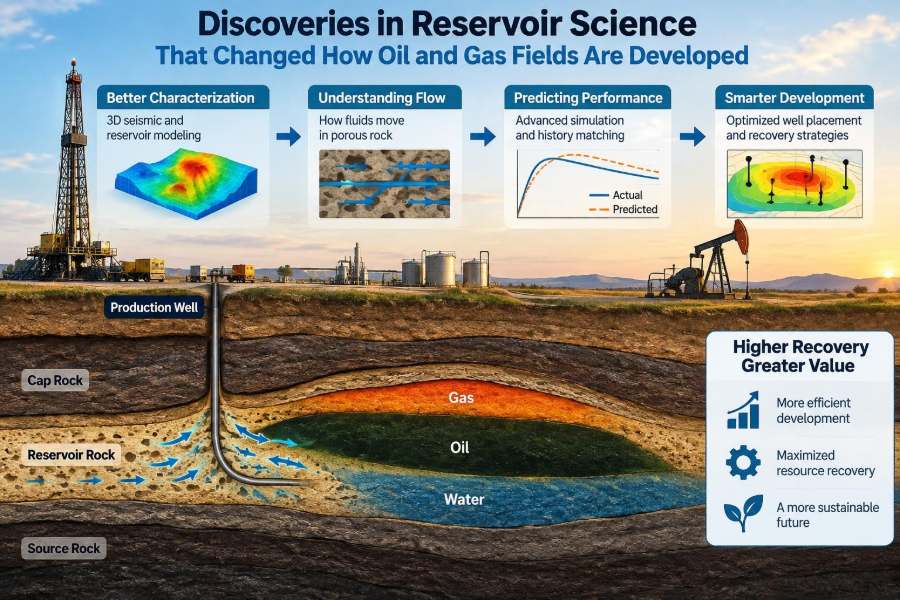

A field can look straightforward on a seismic map: a promising structure, a thick reservoir interval, and a planned well location near the crest. Then the first well produces less water than expected, the second communicates with a fault block no one had connected, and pressure behavior reveals that the “single tank” was actually several compartments.
Those outcomes are not simply drilling surprises. They are reminders that an oil or gas field is a dynamic subsurface system, shaped by rock texture, fluid properties, pressure, fractures, and geological boundaries. Reservoir science developed because early production experience repeatedly showed that surface observations alone were not enough.
Several discoveries fundamentally changed field development. They changed where wells are placed, why pressures are measured, how recovery is forecast, and when water or gas injection is worth the cost and risk.
For students, these ideas provide the logic behind reservoir engineering workflows. For working professionals, they remain practical: better development decisions still come from testing assumptions against rock, fluids, and field-scale performance.
🪨 Reservoirs Are Rock Systems, Not Underground Lakes
One of the most consequential corrections in petroleum history was abandoning the picture of oil stored in large underground caverns. Most conventional hydrocarbon accumulations reside in tiny, connected pore spaces between mineral grains or within fractures.
That distinction changes everything. A reservoir’s producibility depends not just on the amount of pore volume, but on whether fluids can move through the connected pathways. Rock can contain substantial hydrocarbons and still deliver poorly if those pathways are narrow, discontinuous, or blocked by clay minerals.
A useful analogy is a sponge rather than a tank. A sponge can hold water, but the ease of squeezing water out depends on its internal structure. Reservoir engineers therefore study both storage and flow.
🫧 Porosity Defined How Storage Is Measured
Porosity is the fraction of bulk rock volume occupied by pores. It provided a practical way to estimate how much fluid a rock may store, whether the fluid is oil, gas, water, or some combination.
Porosity is not uniform across a reservoir. Grain sorting, compaction, cementation, dissolution, and clay content can all alter it. A sandstone interval with visually similar rock may contain zones with very different pore volumes.
Modern petrophysical interpretation uses logs, core, and other measurements to estimate porosity. Each method has uncertainty: core samples are limited in location, while log responses must be interpreted through assumptions about minerals and pore fluids.
🚪 Permeability Explained Why Some Wells Flow
Storage alone does not produce a commercial well. Permeability describes the rock’s ability to transmit fluids through connected pores. It is the discovery that explained why two rocks with similar porosity can perform very differently.
In simple terms, porosity asks, “How much space exists?” Permeability asks, “Can fluid travel through it?” Fine pore throats, pore-filling cements, and clays can severely restrict flow even when total porosity looks attractive.
This insight shifted development from seeking “good-looking reservoir” to mapping flow capacity. Well spacing, expected rates, stimulation design, and recovery forecasts all depend on it.
🧩 Heterogeneity Ended the Average-Rock Assumption
Early calculations often treated reservoir properties as relatively uniform averages. Field performance made clear that reservoirs are commonly heterogeneous: properties vary vertically, laterally, and at scales smaller than well spacing.
Thin low-permeability layers may divert injected water. A high-permeability streak can carry water rapidly to a producer while leaving oil behind nearby. In carbonate reservoirs, vugs and fractures may dominate flow even if matrix rock holds most of the fluid.
Average values are still useful, but they can conceal the mechanisms that control recovery. Reservoir models now use facies, logs, cores, seismic interpretation, and production data to represent meaningful variation rather than a single idealized rock.
🌊 Darcy’s Law Put Flow on a Quantitative Footing
Henry Darcy’s experiments established a relationship between flow rate, pressure gradient, fluid viscosity, and rock permeability. Darcy’s law became a foundation of reservoir engineering because it turns the intuitive idea of “fluids flow from high pressure to low pressure” into a usable calculation.
For a single fluid flowing through a porous medium, higher permeability and a larger pressure difference support more flow. Higher viscosity resists it. Real reservoirs add geometry, multiple fluids, changing pressure, and complex boundaries, but the basic relationship remains central.
Darcy’s law also taught an important limitation: production rate is not evidence of reserves by itself. A high rate can result from strong pressure support or a highly permeable pathway, while a large volume of oil may remain inaccessible at practical rates.
💧 Capillary Pressure Revealed That Fluids Do Not Separate Cleanly
Oil, gas, and water in a reservoir do not usually sit behind perfectly flat, sharp interfaces. In small pores, surface tension and rock wettability create capillary pressure, which affects where each fluid resides.
Fine-grained rocks can hold water strongly in small pores. Larger pores may be more easily occupied by hydrocarbons. This creates transition zones in which water and hydrocarbons coexist rather than a sudden change from one fluid to another.
Ignoring capillary behavior can overstate hydrocarbon saturation near contacts and lead to poor perforation choices. It also matters when engineers evaluate carbon dioxide storage or water injection, where multiphase fluid distribution remains critical.
🧲 Wettability Changed the Meaning of Water Saturation
Wettability describes which fluid preferentially spreads on the rock surface. A water-wet rock tends to retain water along grain surfaces and in smaller pores, while oil-wet behavior can redistribute fluids differently.
This microscopic property influences relative permeability, capillary pressure, residual oil, and the response to waterflooding. It is not always uniform: wettability may vary between rock types or change after long exposure to crude oil.
Laboratory measurements help, but restoring a core sample to representative reservoir conditions is difficult. Engineers should treat wettability data as evidence to integrate with field behavior, not as a universal label for an entire field.
🔀 Relative Permeability Made Multiphase Flow Understandable
A reservoir rarely contains only one mobile fluid. Oil, water, and gas can move simultaneously, but each phase reduces the flow capacity available to the others. Relative permeability captures this effect.
For example, as water saturation rises near a producing well, water may gain mobility while oil relative permeability falls. The well can then produce more water and less oil even when oil remains in the surrounding rock.
This discovery gave engineers a way to model water breakthrough, gas coning, and displacement efficiency. It also explains why a waterflood cannot simply be judged by injected volume: the saturation path and rock-fluid system determine where the water goes.
🧪 PVT Science Connected Surface Samples to Reservoir Fluids
Oil and gas change character as pressure and temperature change. Pressure-volume-temperature, or PVT, analysis describes these fluid behaviors under reservoir-relevant conditions.
As pressure declines, dissolved gas can emerge from oil below the bubble-point pressure. Gas may help drive fluids initially, but it can also reduce oil mobility and create gas handling constraints. Gas-condensate systems introduce another challenge: liquid can condense near the wellbore as pressure falls.
PVT sampling and laboratory analysis made it possible to estimate formation volume factors, solution gas behavior, viscosities, and phase boundaries. These inputs are essential for material balance, simulation, facilities sizing, and reserves estimation.
📉 Pressure Depletion Became a Diagnostic Tool
Pressure is more than a production constraint; it is a record of reservoir behavior. Repeated pressure measurements reveal whether a reservoir is depleting, receiving aquifer support, communicating across faults, or responding to injection.
A rapid, widespread pressure decline may indicate limited natural support. Stable pressure near producers could point to an active aquifer or injection response, although measurement quality and timing must be checked before drawing conclusions.
Pressure surveillance transformed reservoir management from rate-focused operation into system diagnosis. In many fields, a shut-in pressure survey can be more valuable for long-term planning than a short period of higher production rate.
⚖️ Material Balance Linked Production to Fluids in Place
Material balance applies conservation of mass to a reservoir. If engineers know what has been produced and understand pressure and fluid expansion, they can estimate the volumes and energy mechanisms contributing to production.
Its power lies in field-scale reasoning. Instead of relying solely on local well observations, material balance asks whether produced fluids, pressure decline, gas liberation, water influx, and rock-fluid expansion tell a physically consistent story.
The method depends on representative pressure and reliable production allocation. Poor pressure data, changing completion intervals, and uncertain water influx can make results ambiguous, so material balance is strongest when used alongside geological and dynamic models.
🌡️ Natural Drive Mechanisms Shaped Development Timing
Reservoirs produce because energy moves fluids toward wells. That energy can come from fluid expansion, solution-gas liberation, a gas cap, an aquifer, gravity drainage, or a combination of mechanisms.
| Drive mechanism | Typical development implication |
|---|---|
| Solution-gas drive | Pressure may decline quickly; gas management and timely pressure support can matter. |
| Water drive | Pressure support may be strong, but water encroachment can limit oil recovery. |
| Gas-cap drive | Gas-cap expansion can support production; excessive gas production may reduce its effectiveness. |
| Gravity drainage | Well placement and controlled rates can be especially important for efficient drainage. |
No drive mechanism is automatically “best.” A strong aquifer may sustain pressure but cause early water production. Understanding the dominant mechanism helps teams choose drawdown, well location, and injection strategy.
🧱 Aquifers Were Recognized as Active Reservoir Partners
An aquifer is water-bearing rock that may communicate with the hydrocarbon-bearing reservoir. It can supply water as hydrocarbons are produced, partially replacing withdrawn volume and moderating pressure decline.
That support can improve recovery, but it introduces uncertainty. Aquifer size, connectivity, recharge behavior, and barriers are often imperfectly known. Water may enter selectively through higher-permeability layers rather than sweeping oil evenly.
Development planning must distinguish between a modest local water source and a large, active aquifer. The difference affects expected pressure, water handling capacity, abandonment timing, and whether artificial water injection adds value.
🗺️ Structural Closure Was Only Part of the Trap Story
Anticlines and fault-bounded closures remain familiar exploration concepts, but reservoir science showed that structure alone cannot define a producible accumulation. A trap also requires effective seal, charge, timing, reservoir quality, and fluid retention.
Faults are particularly uncertain. One fault may seal because of clay smear or juxtaposition against impermeable rock; another may leak or transmit fluids through connected sands. Their behavior is rarely established from a map alone.
For development, faults can create compartments with separate pressure systems. Treating them as either perfectly sealing or fully open without evidence is a common source of forecast error.
🪜 Stratigraphic Traps Expanded the Search Area
Not all accumulations are held by obvious structural closure. Stratigraphic traps form through changes in rock type, pinch-outs, unconformities, reefs, channels, or permeability barriers.
These traps changed exploration and development because their boundaries may be subtle and their reservoir quality may vary strongly. A sand body can thin laterally into shale, while a carbonate buildup can contain highly variable pore systems.
They demand integration. Seismic geometry, well logs, cores, depositional interpretation, and pressure data all contribute to locating boundaries that cannot be inferred from structure alone.
🧭 Seismic Imaging Moved Reservoir Models Beyond Wells
Wells provide detailed but narrow samples. Seismic data offered a way to map larger-scale structure and, under suitable conditions, reservoir geometry between wells.
Seismic interpretation can identify faults, horizons, channel forms, and some stratigraphic changes. In favorable settings, calibrated seismic attributes may help distinguish facies trends or fluid-related effects. But seismic resolution is limited, and an apparent feature is not automatically a permeability boundary.
The most useful workflow ties seismic interpretation to well control. A reservoir model should preserve what the seismic can support while avoiding false precision at scales the data cannot resolve.
🧱 Core Analysis Grounded Log Interpretation in Real Rock
Core samples made reservoir properties tangible. They allow direct examination of grain size, pore type, fractures, sedimentary structures, saturation, and selected laboratory measurements of porosity, permeability, capillary pressure, and relative permeability.
Core is powerful precisely because it reveals what logs infer indirectly. A low-resistivity interval may represent shaly sand, conductive formation water, complex pore geometry, or a combination; core can help resolve the geological context.
Still, a core is a tiny sample and may be altered during retrieval. Good practice combines core evidence with logs, pressure data, and production behavior rather than extending a few plugs unquestioningly across a field.
📡 Well Logs Turned Boreholes into Continuous Measurements
Wireline and logging-while-drilling tools transformed subsurface evaluation by measuring formation responses continuously along the wellbore. Gamma ray, resistivity, density, neutron, sonic, and image logs each contribute different information.
Resistivity commonly helps assess fluid saturation, while density and neutron responses contribute to porosity interpretation. None provides a final answer alone. Mineralogy, invasion, borehole conditions, salinity, and shale content can all affect readings.
The major lesson is interpretive discipline: logs are measurements of physical responses, not direct labels saying “oil,” “gas,” or “water.” Calibration and cross-checking remain essential.
🧫 Reservoir Characterization Became an Integrated Discipline
As datasets grew, reservoir characterization emerged as the practice of building a coherent description of rock, fluids, structure, and connectivity. It combines geology, geophysics, petrophysics, reservoir engineering, and production knowledge.
The goal is not an elaborate model for its own sake. It is a decision-ready understanding: which intervals to complete, where uncertainty is largest, whether two wells communicate, and what surveillance would most reduce risk.
Integration often exposes conflicting interpretations. That is useful. A mismatch between pressure data and a geological model may reveal a missing barrier, an incorrect contact, or a measurement problem worth investigating.
💻 Numerical Simulation Tested Development Choices Before Capital Is Committed
Reservoir simulation represents flow through a gridded model over time. Engineers use it to test well placement, production constraints, injection scenarios, facility limits, and alternative geological realizations.
A simulation is not a prediction machine. Its output depends on assumptions about rock properties, relative permeability, faults, aquifer behavior, fluid properties, and operating conditions. A visually sophisticated model can still be wrong for simple reasons.
Its greatest value is structured comparison. If several plausible models all show early water breakthrough for a proposed injector-producer pattern, that is a useful warning. If results diverge widely, the uncertainty itself should guide surveillance and phased development.
🧷 History Matching Made Models Answer to Field Evidence
History matching adjusts a reservoir model so it reproduces observed production rates, water cuts, gas-oil ratios, pressures, and other dynamic data within reasonable limits. It is where static interpretation meets actual field behavior.
Matching is not merely curve fitting. A model can match total field oil while getting the wrong water movement or pressure communication for the wrong physical reasons. Those errors can mislead future forecasts.
Credible history matches preserve geological plausibility and use multiple data types. Teams should document parameter changes and alternatives, especially when uncertain properties such as fault transmissibility or aquifer strength exert strong influence.
💉 Waterflooding Demonstrated the Value—and Difficulty—of Pressure Support
Water injection became a cornerstone of secondary recovery because injected water can help maintain pressure and displace oil toward production wells. It is often practical where water supply, injectivity, facilities, and reservoir conditions are suitable.
Its limitations arise from heterogeneity and unfavorable mobility. Water may channel through high-permeability zones, bypassing lower-permeability oil-bearing rock. Injected and produced water also require treatment, monitoring, and reliable containment.
Successful waterflood design considers pattern geometry, layer communication, injection rate, water quality, fracture pressure, and surveillance. The question is not whether water can be injected, but whether it will improve sweep without creating unacceptable water handling or containment problems.
🔥 Enhanced Oil Recovery Expanded the Recovery Toolbox
Enhanced oil recovery, or EOR, seeks to mobilize or displace oil that conventional depletion and waterflooding leave behind. Thermal processes can reduce heavy-oil viscosity, while gas injection, chemical methods, and other approaches target different rock-fluid mechanisms.
Miscible gas injection can reduce interfacial effects under suitable pressure and fluid conditions. Steam-based methods can be effective in some heavy-oil settings, but require substantial energy and facilities. Chemical approaches face challenges involving retention, salinity, temperature, and project complexity.
EOR is therefore a screening and design problem, not a generic late-life remedy. Laboratory work, fluid studies, simulation, pilots, economics, emissions considerations, and operational readiness all influence whether a project is viable.
🪵 Fractures Changed the Meaning of Connectivity
Natural fractures can provide highly conductive flow paths in otherwise tight rock. They can improve deliverability, connect matrix storage to wells, or create rapid water and gas movement that complicates recovery.
Fractured reservoirs are difficult because fracture properties vary in orientation, aperture, length, and connectivity. A well may intersect a productive fracture corridor while a nearby well does not, making simple interpolation unreliable.
Induced hydraulic fractures add another dimension. They can create access to low-permeability rock, but performance depends on fracture geometry, stress contrasts, fluid behavior, proppant placement, and interaction with natural fractures.
🛢️ Unconventional Reservoirs Redefined What “Reservoir” Means
In shale and other tight formations, the source rock may also contain hydrocarbons, but permeability is so low that commercial production typically requires horizontal wells and multistage hydraulic fracturing. This changed development from isolated well targeting to repeatable manufacturing-style programs.
Reservoir science had to address nanoscale pores, adsorption, complex multiphase flow, stress sensitivity, fracture networks, and rapidly changing near-well conditions. Conventional assumptions may still offer insight, but they cannot simply be transferred without adaptation.
Spacing and completion design are especially uncertain. Wells drilled too closely may interfere; wells spaced too far apart may leave economically recoverable rock undeveloped. Interference tests, production trends, and disciplined pilots help narrow this uncertainty.
📈 Production Surveillance Turned Operations into Continuous Learning
Field development does not end when wells start producing. Rate, pressure, water cut, gas-oil ratio, injection performance, tracer information, and downhole measurements can reveal changing reservoir conditions.
Surveillance supports practical decisions such as identifying a leaking completion, diagnosing water breakthrough, adjusting choke settings, selecting workover candidates, or evaluating injector-producer communication. The best data are those linked to a clear decision.
Collecting every possible measurement is not always efficient. A surveillance plan should ask what uncertainty matters, what observation can reduce it, and how the result would change the operating or investment decision.
⚠️ Common Development Mistakes Repeat When Uncertainty Is Hidden
Reservoir science has advanced, yet several avoidable mistakes remain common when teams treat uncertain interpretations as facts.
- Using one average property: this can hide flow barriers, thief zones, and bypassed intervals.
- Assuming pressure communication from proximity: nearby wells may be separated by faults or stratigraphic barriers.
- Equating hydrocarbons in place with recoverable reserves: recovery requires a feasible flow and development mechanism.
- Overmatching a simulation model: fitting past data with unrealistic parameters weakens forecast credibility.
- Ignoring facilities and water management: reservoir plans fail operationally when produced fluids cannot be handled safely and reliably.
The remedy is not endless analysis. It is making assumptions visible, ranking uncertainties by decision impact, and collecting the right evidence before committing to irreversible spending.
🌍 Reservoir Science Now Supports More Than Hydrocarbon Recovery
The same concepts used in oil and gas development also matter for carbon dioxide storage, geothermal projects, underground gas storage, and some subsurface energy applications. Porosity, permeability, caprock integrity, pressure management, faults, and multiphase flow remain central.
There are important differences. Carbon storage requires long-term containment and monitoring, while geothermal development focuses on heat extraction and fluid circulation. Yet reservoir engineering’s systems perspective is directly relevant.
This broader role makes foundational reservoir science valuable across an evolving energy sector. The skills of integrating uncertain data and managing subsurface flow are transferable, not limited to one commodity.
🧠 The Core Principle: Development Must Follow Reservoir Behavior
The discoveries described here share one theme: field development improves when it follows the actual behavior of rock and fluids rather than a convenient simplified picture. Porosity explains storage; permeability and relative permeability explain movement; pressure and production data reveal energy and connectivity.
Geology provides the framework, measurements constrain it, and models test consequences. None is sufficient alone. A core sample cannot map a field, seismic cannot directly measure every flow path, and a simulation cannot remove uncertainty from incomplete data.
The most durable practice is an iterative loop: characterize the reservoir, select a development action, observe the response, update the interpretation, and adapt. That approach reduces surprises without pretending the subsurface can ever be known perfectly.
The fields developed most responsibly are not those with the most elaborate models, but those where decisions remain anchored to rock, fluid, pressure, and observed performance. That is the lasting contribution of reservoir science to petroleum engineering. 🛢️🧭